





Marcos hits China’s illegal actions in South China Sea in Asean-US Summit


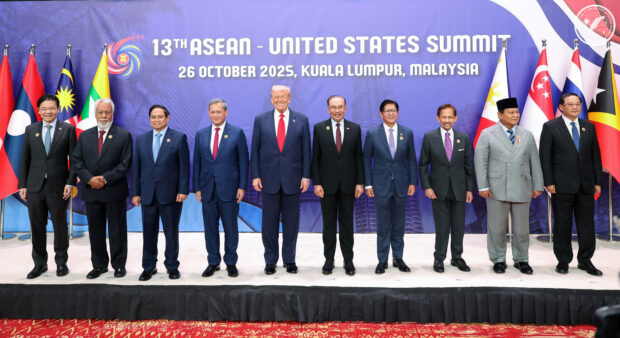
President Ferdinand Marcos Jr. joins US President Donald Trump Jr. and other Asean leaders during the Asean-US Summit in Kuala Lumpur, Malaysia on Oct. 26, 2025. —Photo from PCO
KUALA LUMPUR, Malaysia — President Ferdinand Marcos Jr. has used the Association of Southeast Asian Nations (Asean) Summit and Related Summits here to criticize China anew on its illegal activities in the South China Sea.
He also used the summits as a platform to inform leaders of different nations, particularly the United States, of the harassments faced by Filipinos in the region.
During his intervention at the Asean-US Summit here on Sunday, Marcos expressed deep concern over the dangerous maneuvers and coercive actions that interfere with legitimate Philippine activities in the West Philippine Sea (WPS), a part of the South China Sea within the country’s 200-nautical mile exclusive economic zone of the country.
Throughout his intervention speech – a copy of which was provided to reporters only on Monday – Mr. Marcos did not identify a specific country.
However, a source, who refused to be identified for lack of authority to discuss issues related to the South China Sea, confirmed that the president was referring to China.
Only China Coast Guard and Chinese maritime militia vessels have engaged in aggressive maneuvers in the WPS.
These actions resulted in injuries among personnel of the Philippine Coast Guard and military, and loss of income for Filipinos who are unable to conduct fishing activities in their traditional fishing grounds.
According to Marcos, these actions violate international law, particularly the United Nations Convention on the Law of the Sea (Unclos).
“On the South China Sea, it is regrettable that incidents continue to occur in the West Philippine Sea that have put the lives of Philippine personnel and the safety of our vessels and aircraft at risk, which violates, not only Philippine sovereignty, but also the traditional fishing rights of Filipinos, as guaranteed by the 1982 Unclos, and the final and binding 2016 South China Sea Arbitration Award, and domestic law,” the president told Asean leaders as well as US President Donald Trump.
For the first time, Marcos himself denounced the move of China to establish the so-called “nature reserve” status over the China-controlled Bajo de Masinloc (Scarborough Shoal) last month.
“[This] clearly violates not only Philippine sovereignty, but also the traditional fishing rights of our people guaranteed by international law, including the 1982 Unclos, and affirmed by the final and binding 2016 Award on the South China Sea Arbitration and relevant domestic laws,” he told the other heads of state.
In September, Manila filed a diplomatic protest against Beijing’s “illegitimate and unlawful action.”
These incidents notwithstanding, Marcos said the Philippines would continue to remain “firm, calm and resolute” in its commitment to the full implementation of the Declaration on the Conduct of Parties in the South China Sea (DOC).
The country also wanted for the parties to achieve productive negotiations toward a Code of Conduct (COC) that is “effective, substantive and consistent with international law, particularly Unclos.”
“This commitment is shared throughout all levels of the government, which desires to conclude an effective and substantive Code of Conduct that can effectively govern the behavior of parties at sea,” the president said.
Marcos’ statement was among his most pointed remarks in calling out China’s bullying in the South China Sea before an audience of international leaders.
Speaking to Asean leaders and Chinese Premier Li Qian during the Asean-China summit in Laos last year, Marcos said substantive progress in the COC negotiations was necessary and all parties must “be earnestly open to seriously managing differences” and reducing tension.
READ: ‘Silence on violations diminishes Asean’
“It is regrettable that the overall situation in the South China Sea remains tense and unchanged. We continue to be subjected to harassment and intimidation,” the president had said.
According to Marcos, the Philippines would seize the opportunity next year when the Philippines chairs Asean for the region to finally adopt a legally binding COC for the South China Sea after more than two decades of discussions.
READ: PH hopeful Asean, China to adopt South China Sea code of conduct in 2026
In 2002, the Asean and China signed the DOC that promises to “enhance favorable conditions for a peaceful and durable solution of differences and disputes among countries concerned.”
Decades on, however, claimant countries — namely the Philippines, China, Taiwan, Vietnam, Malaysia, Brunei and Indonesia — have not arrived at a solution for any of the disputes, with coercive and provocative acts racked up into serious tensions.
Countries, especially the Philippines, have since pushed for a CC not only to overcome the DOC’s weaknesses but also address new challenges since 2002.
In the case of the Philippines, the DOC did not stop China from seizing control of Ayungin (Second Thomas) Shoal in 2012 after a tense standoff with the Philippine Navy, and the water-cannoning and ramming of Filipino ships in recent years.
The Philippines brought an arbitral case against China before the Permanent Court of Arbitration in the Hague, Netherlands in 2013.
Three years later in 2016, the international tribunal upheld the Philippines’ sovereign rights to fish and exploit resources within its EEZ and rejected China’s sweeping claims over practically the entire South China Sea.
Beijing, however, has refused to acknowledge the ruling, claiming it has sufficient historical and jurisprudential basis. /apl


