





China’s ‘nature reserve’ in WPS: Playbook for expansionism


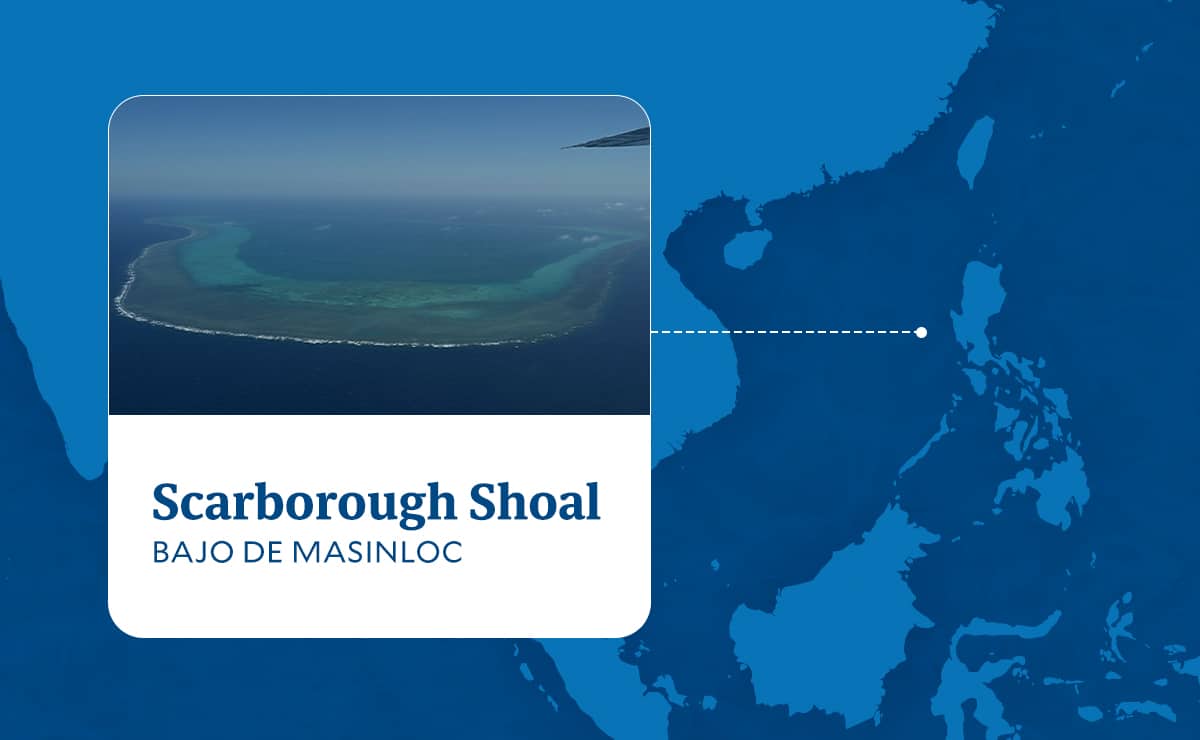
SCARBOROUGH SHOAL composite image from Inquirer stock, Jam Sta Rosa/AFP file photos
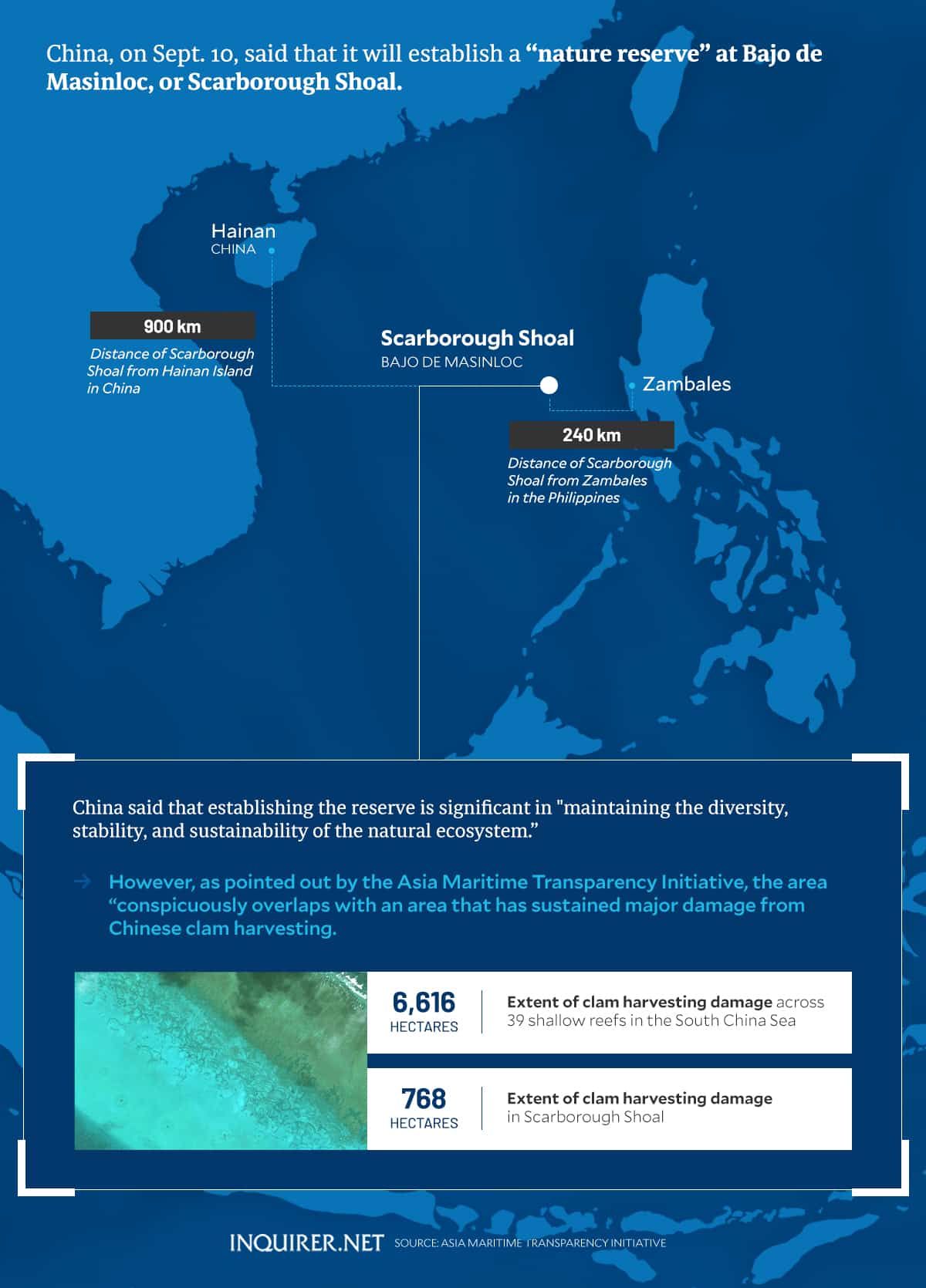
China’s establishment of a “nature reserve” at Bajo de Masinloc, or Scarborough Shoal, which is 900 kilometers from Hainan Island, should not be viewed in isolation but based on the pattern of China’s aggression.
This was pointed out by defense and international relations analysts as China announced the creation of the reserve to maintain “the diversity, stability, and sustainability of the [shoal’s] natural ecosystem.”
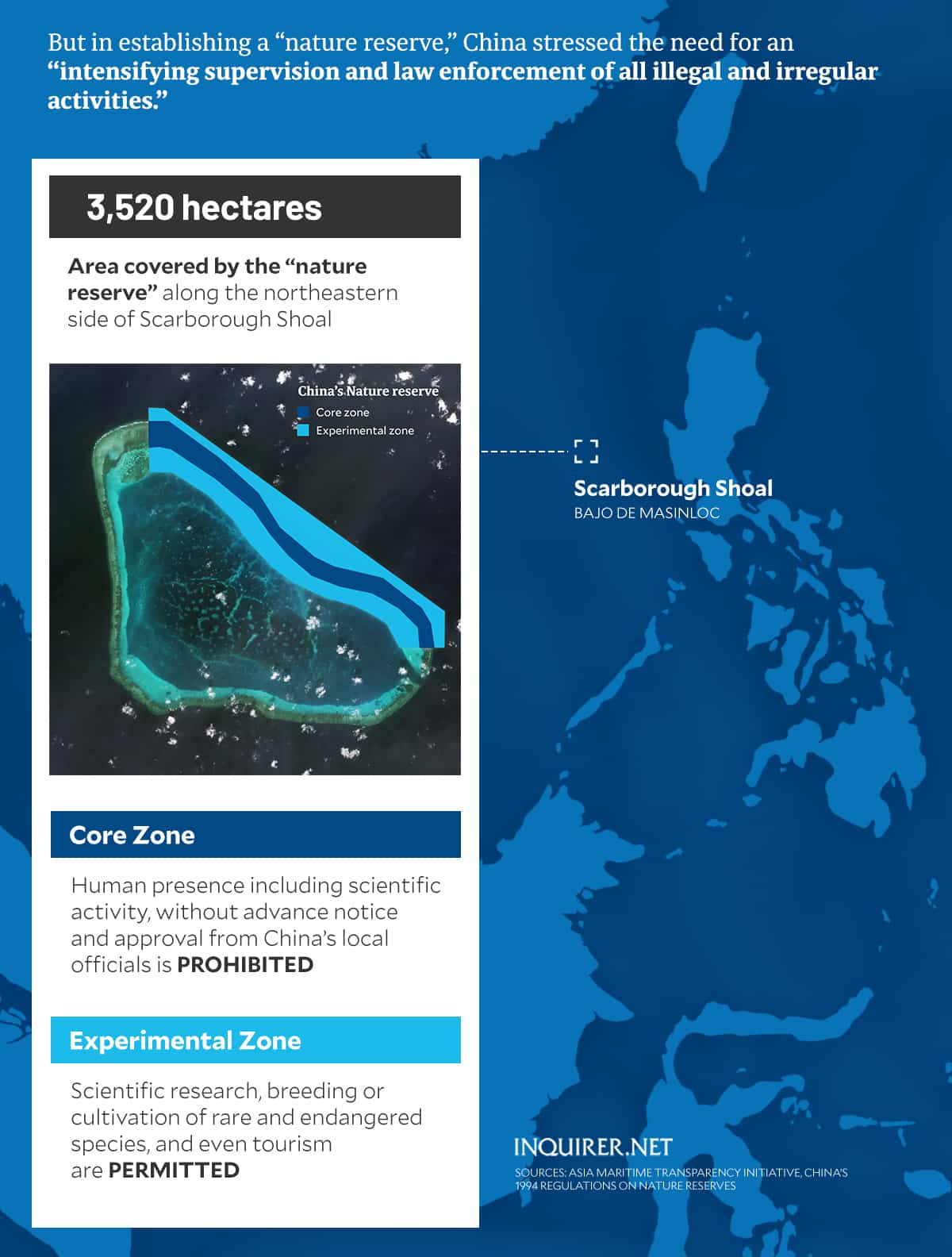
The Asia Maritime Transparency Initiative (AMTI) of the think tank Center for Strategic and International Studies said the reserve covers an area of 3,520 hectares along the northeastern side of Scarborough Shoal.
It consists of two parts: a “core zone,” which covers Bajo de Masinloc’s fringing reef, and what China calls an “experimental zone” around it extending 400 to 800 yards into the waters on either side.
As Chester Cabalza, president of the think tank International Development and Security Cooperation, said, “this sudden move […] comes from China’s scrupulous action to nullify the 2016 arbitral award.”
READ: PH wins arbitration case over South China Sea
The shoal, only 240 kilometers from the province of Zambales, has been declared as a traditional fishing ground for both Filipino and Chinese fishermen and that China had interfered with these rights in restricting access.
GRAPHIC: Ed Lustan/INQUIRER.net
China is “trying to implicate their new legal and environmental domestic law by making Scarborough Shoal a nature reserve since their de facto control in 2012,” he told INQUIRER.net.
As the AMTI explained, the core and experimental zones “have their origins” in China’s 1994 Regulations on Nature Reserve, which was last revised in 2017, “giving some indication as to the restrictions that could be imposed in each zone.
RELATED STORY: China to establish nature reserve at disputed Scarborough Shoal
Based on the text of the regulations, the “core zone” is off limits to all human presence, including scientific activity, without advance notice and approval from provincial or municipal officials.
GRAPHIC: Ed Lustan/INQUIRER.net
The “experimental zone,” meanwhile. is more permissive, allowing scientific research, the breeding or cultivation of rare and endangered species, and even tourism-related activities.
But for the National Security Council (NSC) of the Philippines, China’s establishment of a reserve at Bajo de Masinloc is illegal, describing it as a threat to the sovereignty of the Philippines.
READ: PH security council rejects China’s nature reserve at Bajo de Masinloc
“True protection of [the shoal] demands cooperation, transparency, and respect for international law; not unilateral declarations that restrict access to Filipino fisherfolk under the guise of conservation,” said NSC Secretary Eduardo Año.
This, as China, in a statement, stressed the need for “intensifying supervision and law enforcement [against] all illegal and irregular activities involving the nature reserve,” which is within the exclusive economic zone (EEZ) of the Philippines.
Pretext
As pointed out by Don McLain Gill, an instructor of international relations at the De La Salle University, the establishment of a nature reserve is a “pretext for furthering China’s expansionist moves at Scarborough Shoal.”
He said China has often used environmental reasons to forward its expansionism, adding that in the late 1990s, China, in imposing a fishing ban in the South China Sea, stressed the need to protect and conserve the marine environment.
READ: Panatag ‘reserve’ a threat to PH fishers’ livelihood
The ban, however, is “employed by China to maximize the operations of its coast guard, which it uses as an instrument for power projection and occupation,” Gill told INQUIRER.net.
Back in 1987, China occupied Kagitingan or Fiery Cross Reef on the pretext of building a weather radar station to assist UNESCO in its global oceanic survey, but now, the dredged and reclaimed reef is already a 270-hectare island.
RELATED STORY: Beijing claims PH fishers may ruin its Scarborough ‘nature reserve’
It has a military airbase with a three-kilometer military grade runway and a seaport.
Likewise, China, in 1995, seized Mischief or Panganiban Reef, explaining back then that the stilt structures it created on the reef “were mere shelters for Chinese fishermen,” said former Supreme Court Senior Associate Justice Antonio Carpio.
Like Kagitingan Reef, Panganiban Reef has been dredged and turned into a 590-hectare island, where China created an air-and-naval base with a three-kilometer military grade runway.
‘Driven by self-interest’
For Cabalza, there is really a need for China and the Philippines “to sit down and talk to clear out things and for Beijing to surrender to Manila the maritime feature in a peaceful and diplomatic manner.”
It was in 2012 when China seized Scarborough Shoal from the Philippines.
From April to June that year, there was a standoff between Philippine and Chinese vessels around Scarborough Shoal, so the US brokered a mutual withdrawal to which both sides agreed.
However, while the Philippine vessels withdrew, the Chinese vessels did not, with China eventually saying in late 2012 that its vessels would remain permanently at Scarborough Shoal.
As Gill pointed out, it is clear that whatever China is doing unilaterally “is not something that is in line with international law but a product of its self-interest [and] narrowly driven expansionist ambitions.”
For him, China’s latest move is “something that should not be viewed in isolation but in a continuous manner based on the patterns that it has been doing in different parts of the West Philippine Sea.”
RELATED STORY: China to turn Panatag into an island? Teodoro asks amid ‘Freudian slip’
Carpio has explained in his book “The South China Sea Dispute” that the shoal is essential for China to complete a triangle of airbases to impose an Air Defense Identification Zone in the South China Sea.
Likewise, an air and naval base at Bajo de Masinloc will allow China to protect the Bashi Channel, which is China’s outlet to the Pacific for its nuclear-armed submarines. “Such an air and naval base is a dagger pointed at Manila,” he said.
Ironic
Interestingly, as the AMTI stressed, the area covered by the reserve that China will establish “overlaps with an area that has sustained major damage from Chinese clam harvesting.”
Back in 2023, it measured about 6,600 hectares of damage from clam harvesting across 39 shallow reefs in the South China Sea, with the damage at Scarborough Shoal hitting 768 hectares, which is “more than any other reef.”
READ: China’s acts of war in West PH Sea accelerating ecological ruin
“The damage from clam harvesting consists of arc shaped scars, created when clam fishers dig up the reef surface by dragging specially made brass propellers in a semicircle around the anchor chain on the front of their boats,” it said.
The AMTI explained that “this method destroys not only the reef area directly contacted by the harvesting, but also surrounding areas of coral that are smothered by the resulting plumes of abrasive sediment.”
RELATED STORY: PH: Unlawful for China to declare ‘nature reserve’ at disputed shoal
As Gill said, it is “ironic that China is the single most destructive actor in the South China Sea when it comes to ignoring the universal standards for preserving marine life and marine biodiversity.”
“[It] is against the very aspects that it seeks to promote,” he said.
China’s move, he stressed, should be viewed with great concern as it is a “clear indication of Beijing’s intent to further revise the status quo to its favor and to limit the sovereign rights of the Philippines.”


