





West Philippine Sea: Giving China the warfare it deserves


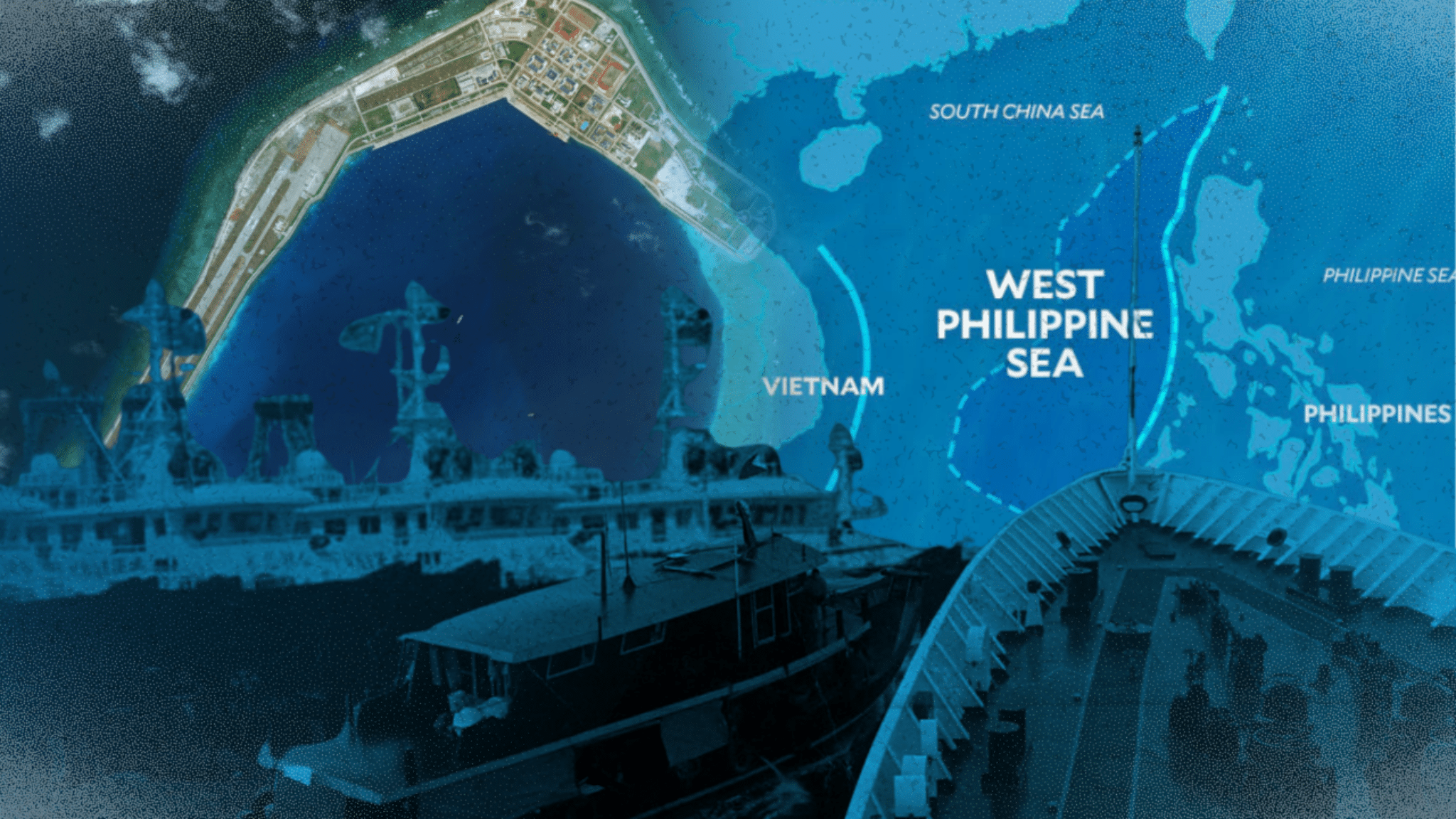
MANILA, Philippines — Once again, China appears to be checking out how far it can go in asserting control over the West Philippine Sea–this time tightening its grip on Scarborough Shoal, which it seized in 2012, while seemingly expecting the Philippines to stay silent, as it did when Rodrigo Duterte was the one in Malacañang.
China, imposing its baseless and illegal nine, now 10-dash line, has said that it has indisputable sovereignty over Scarborough Shoal, which is 900 kilometers from its southernmost province, the Hainan Island. The shoal, however, which the Philippines calls Bajo de Masinloc, is only 240 kilometers away from Zambales.
For the China Coast Guard (CCG), the presence of Filipinos at Scarborough Shoal is deemed illegal—an alleged intrusion into what China claims as its sovereign territory over most of the South China Sea. They have consistently issued warnings to local fishermen and intercepted Philippine vessels in the area.
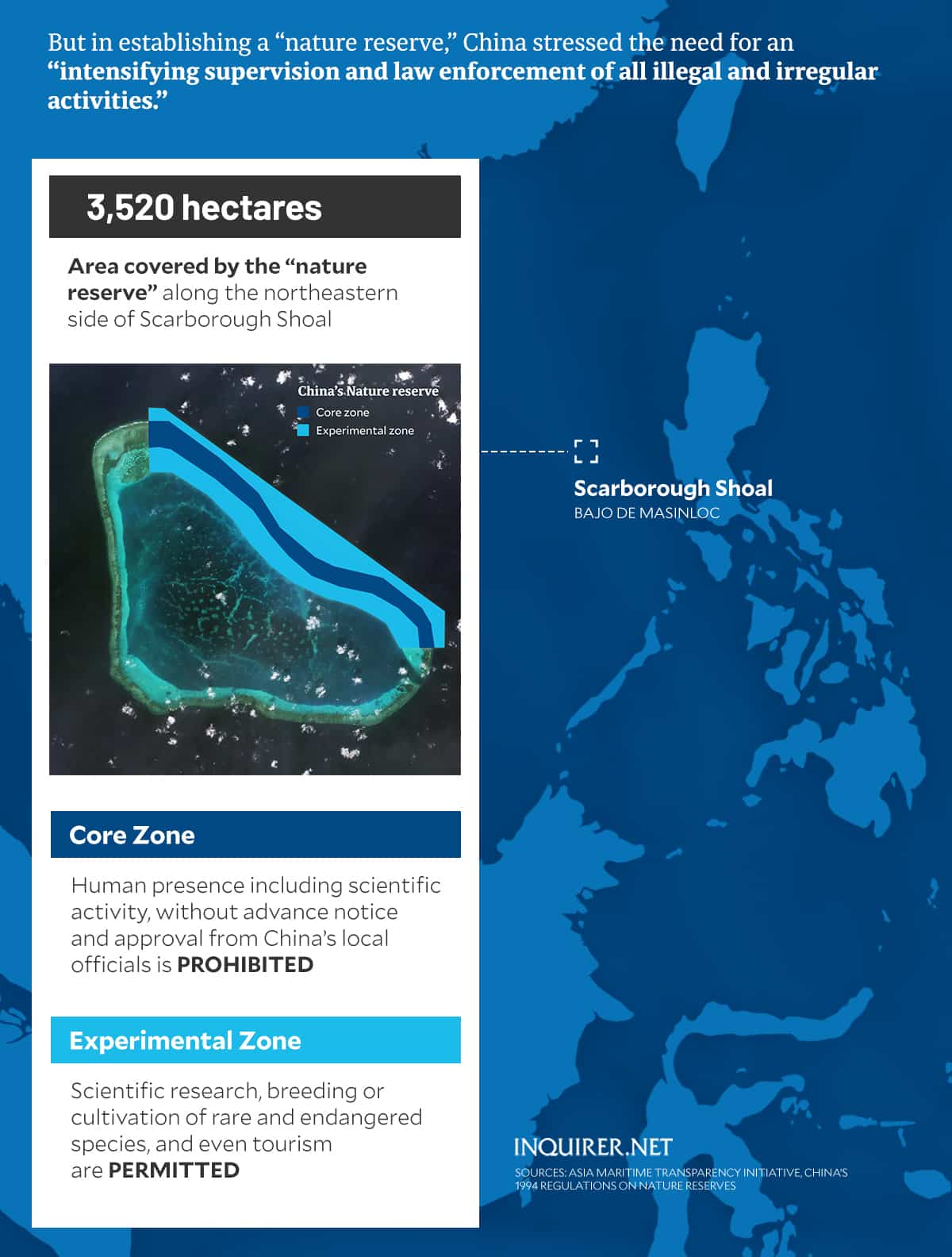
Last Sept. 10, China even unilaterally declared the shoal as a “nature reserve,” where human presence, including scientific activity, is prohibited at the “core zone” without advance notice or permission from provincial or municipal officials in China.
Chester Cabalza, president of the think tank International Development and Security Cooperation, previously pointed out that China, implicating its domestic law by establishing the reserve, wants the Philippines to “abandon its claim” over Scarborough Shoal.
For Elaine Tolentino, former chairperson of De La Salle University’s Department of International Studies, declaring Scarborough Shoal as a reserve would establish sovereignty in the perspective of the government of China, which is relentless in its aggression even inside the Philippines’ exclusive economic zone (EEZ).
China’s key
Based on the study “Geopolitics of Scarborough Shoal,” which was written in 2012 by François-Xavier Bonnet, the shoal, which China calls Huangyan Dao, is essential for its claim over Zhongsha Qundao and consequently to the features located inside its controversial nine, now 10-dash line.
All banks and shoals inside Zhongsha Qundao, except for Scarborough Shoal, are below several meters of water even in low tide, said the report, so China is well-aware that without the shoal, it will lose Zhongsa Qundao, which could be divided by the EEZs of neighboring states.
So to back its claim, China describes Bajo de Masinloc as an island because such a status would allow China to draw and extend its baselines from the shoal–a territorial sea, a contiguous zone, an EEZ, and as well as a continental shelf, which would result to China having a “huge and disproportionate maritime territory.”
READ: Beijing claims PH fishers may ruin its Scarborough ‘nature reserve’
A little over a month since the establishment of the reserve, the CCG broadcast challenges against the Philippine Coast Guard, asserting that the presence of Filipino fishermen could ravage the reserve, which, ironically, has already sustained major damage from China’s giant clam harvesting.
The Philippine Coast Guard (PCG), however, hit China for its “dangerous maneuvers and blocking actions,” pointing out that the shoal is an “integral part of the Philippine archipelago, and only the Philippine government holds the authority to designate environmental protection areas in these waters.”
PCG’s response came as the Department of Foreign Affairs previously bared its plan to initiate a diplomatic protest against China, with National Security Adviser Eduardo Año describing the declaration of the reserve as a pretext for “eventual occupation.”
Silence
Over the years, China has transformed shoals and reefs into sprawling military outposts, reshaping most of the South China Sea and extending its reach into waters inside the Philippines’ EEZ, especially since reclamation and militarization have proceeded with little to no interference.
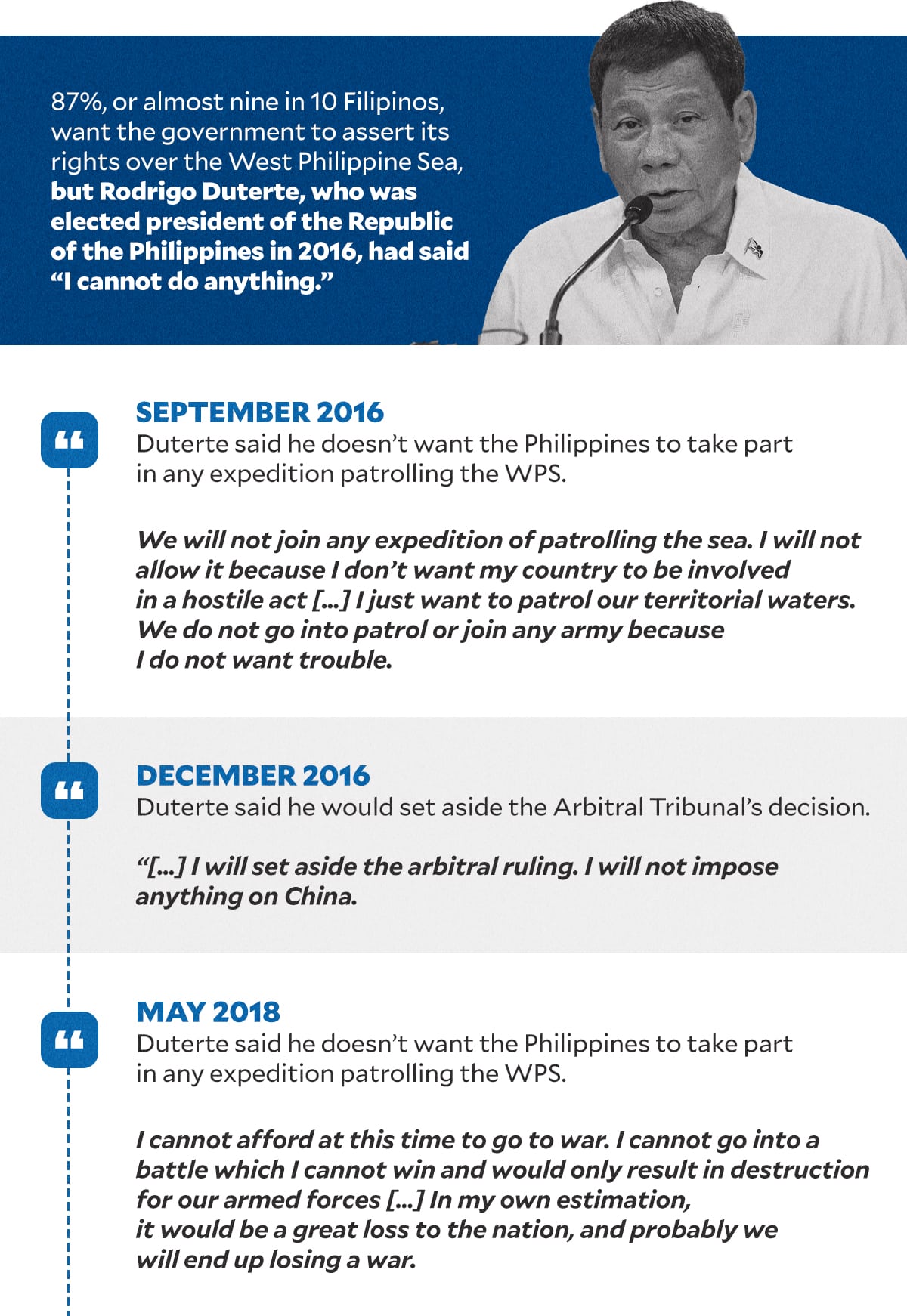
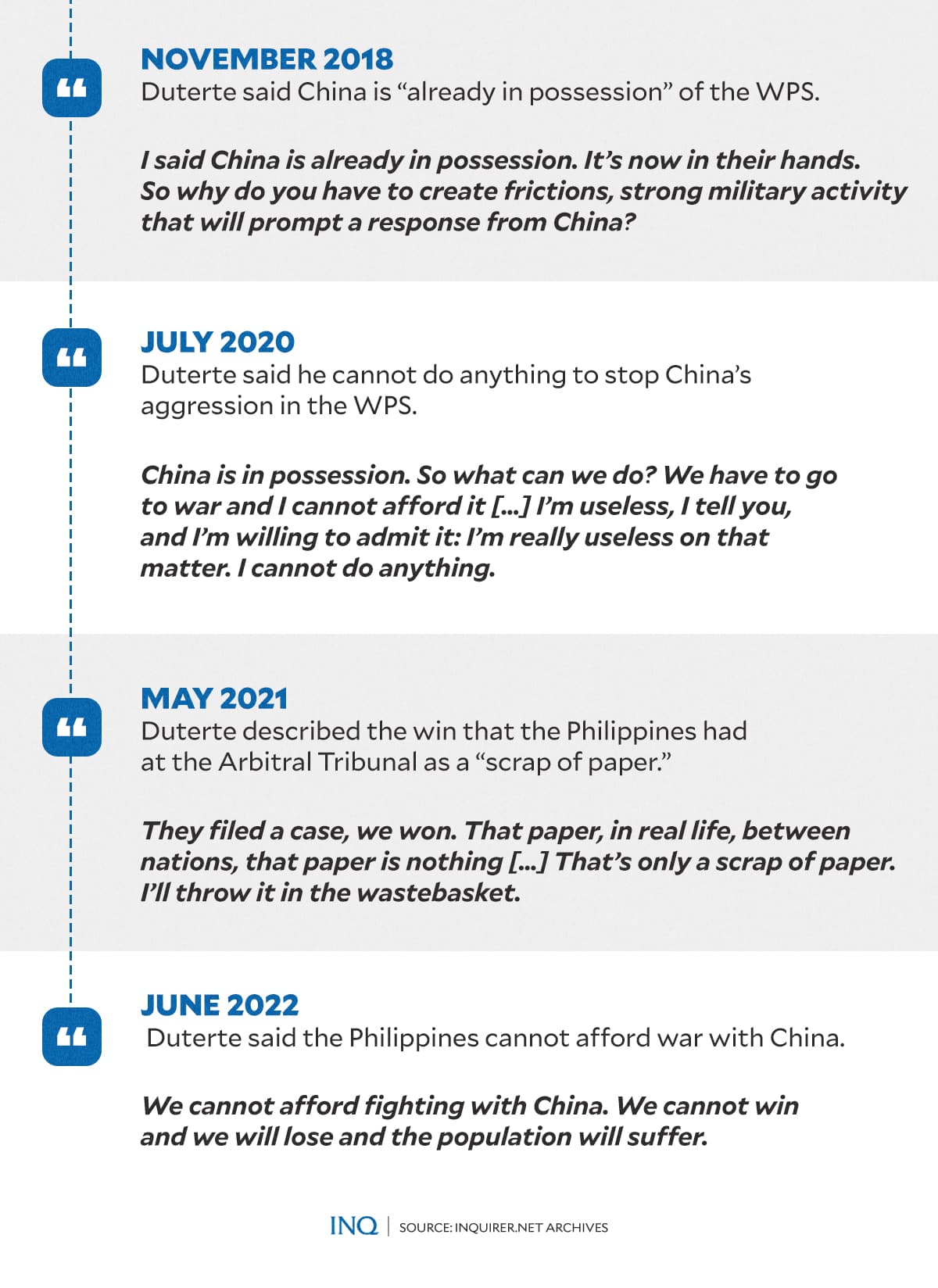
Despite the 2016 arbitral win that invalidated China’s nine, now 10-dash line, responses by the government, which was led by Duterte from 2016 to 2022, have often been hesitant, with Malacañang choosing engagement over confrontation in exchange for promises of economic cooperation.
READ: When words, actions speak loud: Duterte’s honeymoon with China
The shift was stark–from the filing of a landmark case by the Benigno Aquino III administration to setting aside Chinese aggression, with Duterte even stating that “China is already in possession. It is now in their hands. So why do you have to create frictions, strong military activity that will prompt a response from China?”
RELATED STORY: Teodoro hits China warning on PH alliance with US
As some pointed out, Duterte’s remarks emboldened China to press its claim with little fear of consequence, considering that Duterte had said at the start of his six-year presidency that it was “time to say goodbye” to the US, which China has consistently warned not to interfere with the issue in the South China Sea.
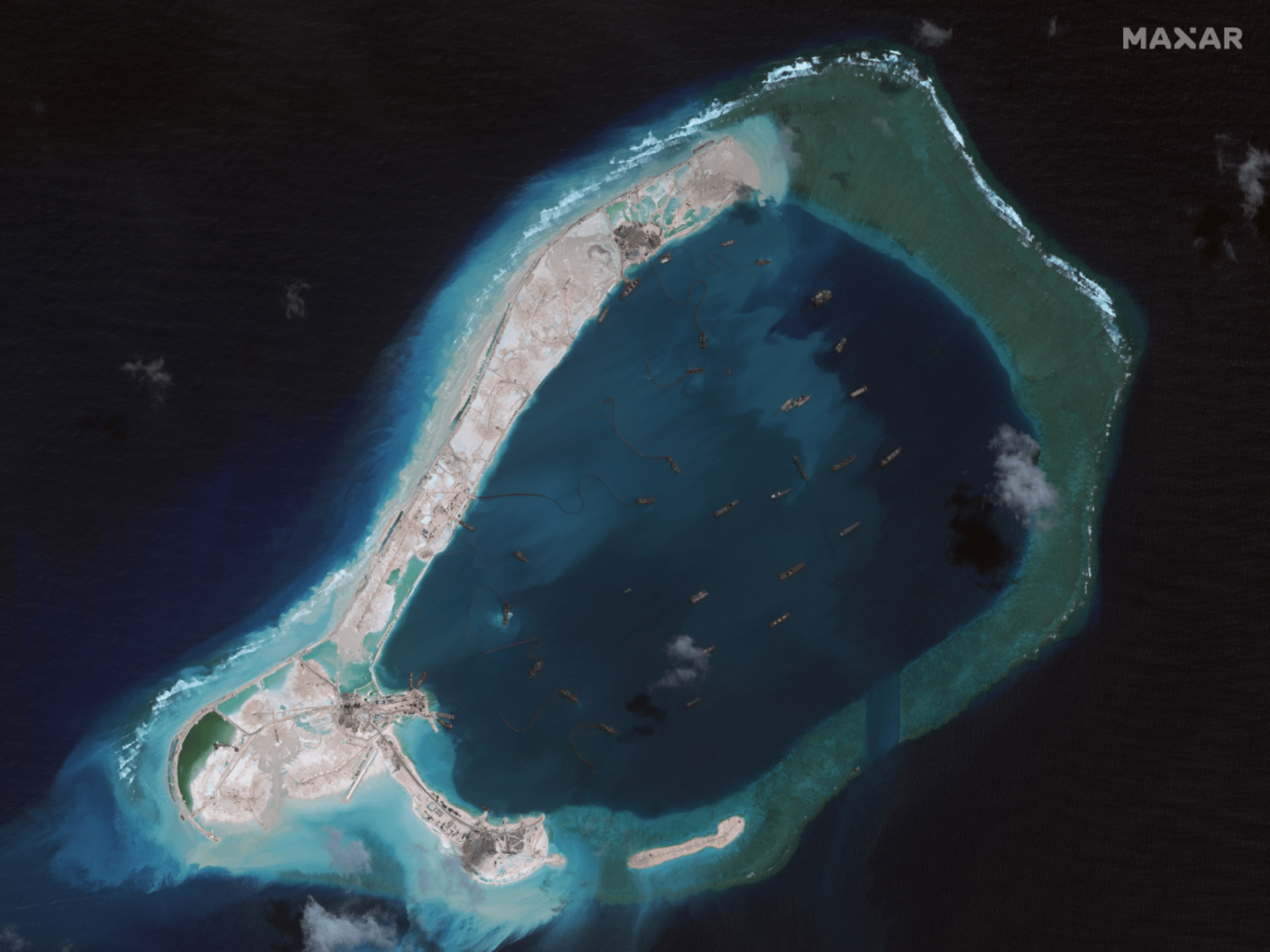
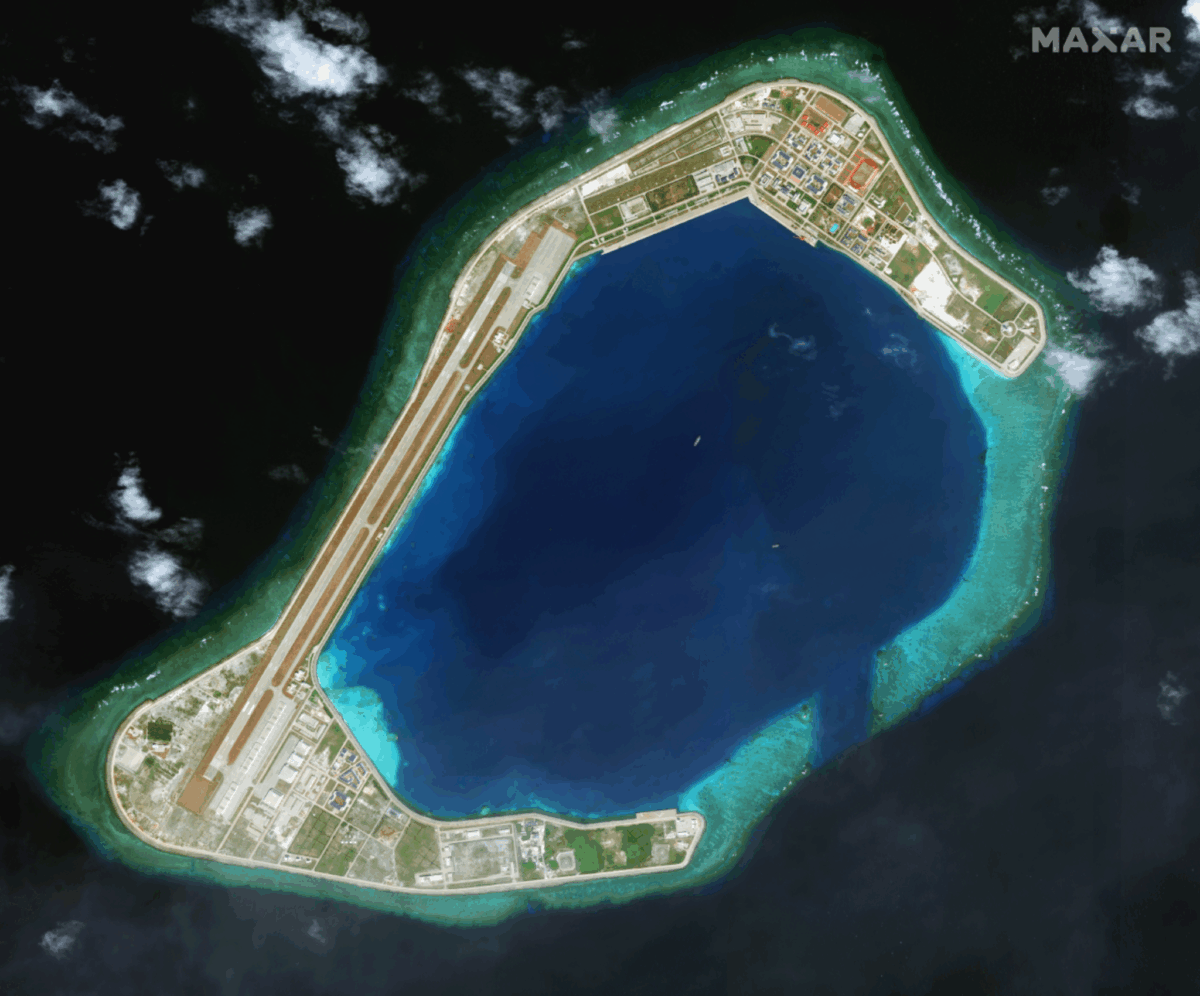
For example, Mischief and Subi Reefs, which are inside the Philippines’ EEZ, have been dredged and were transformed into artificial islands serving as an air-and-naval bases with military grade airstrips, as seen in these comparative satellite images from 2015 and 2022 provided by Maxar.
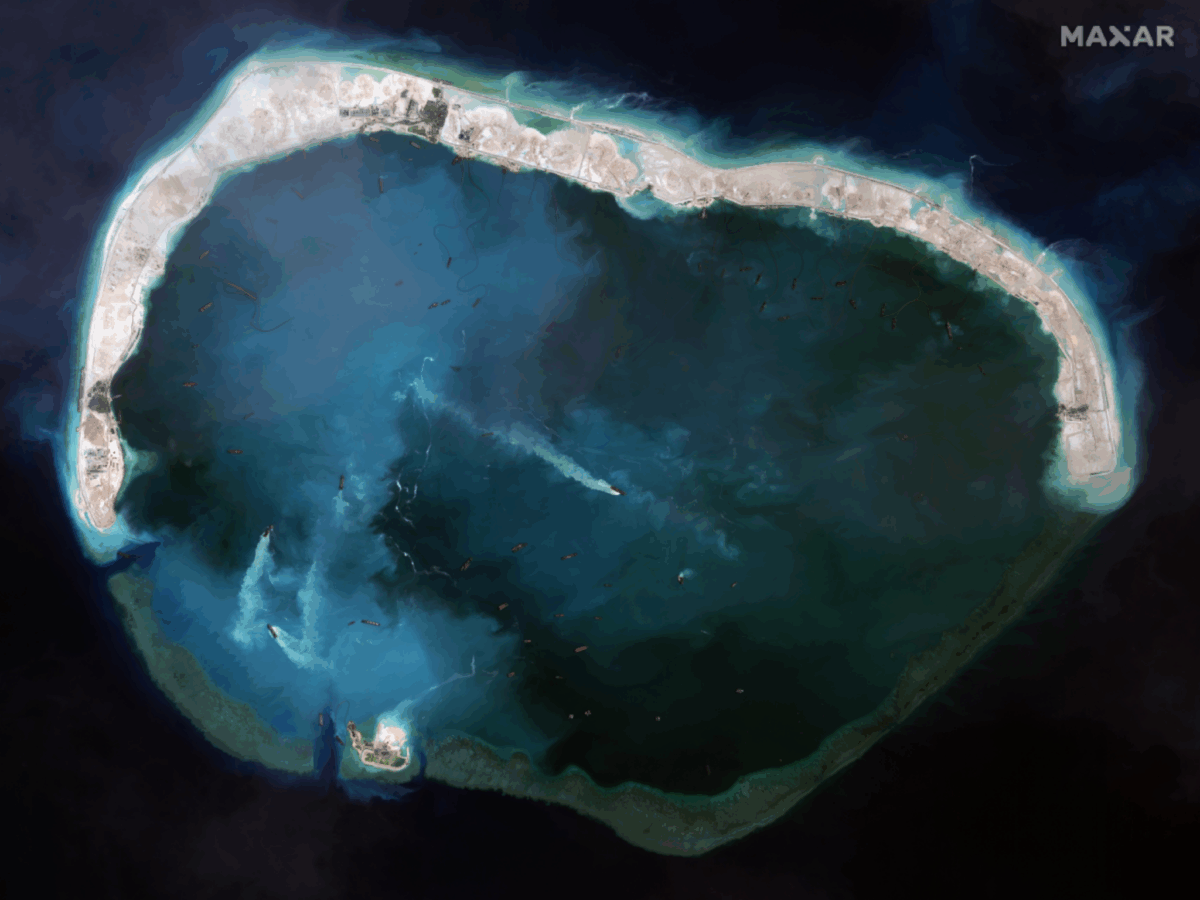
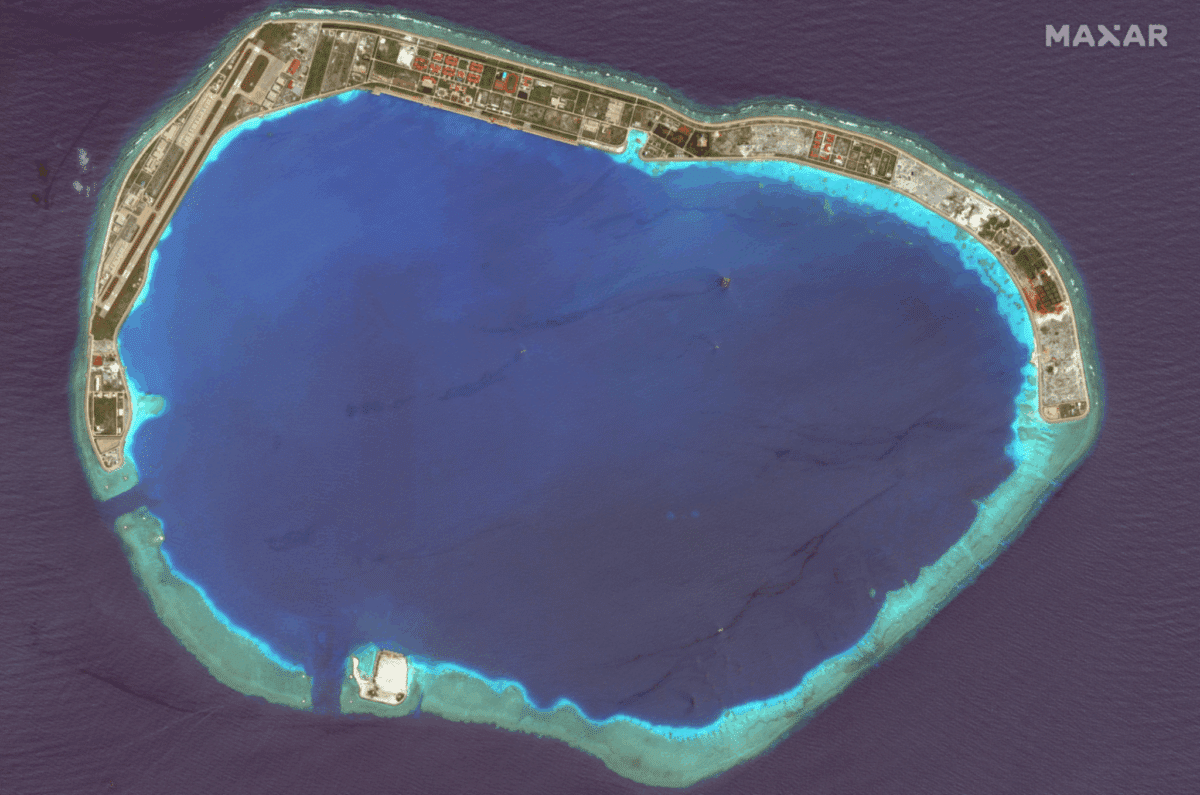
As Chinese vessels swarm shoals and reefs within the West Philippine Sea, reclamation and militarization proceeded largely unchecked even when fishermen were being driven away from traditional fishing grounds, while PCG men faced harassment from larger and more aggressive Chinese vessels.
No complacency
Almost a decade since the arbitral win that once promised to strengthen the Philippines’ maritime stand, the country finds itself grappling with the cost of inaction. China’s grip has only deepened, with its government now asserting that Scarborough Shoal is a feature it can declare as a nature reserve.
RELATED STORY: West PH Sea: When diplomatic protests vs China fail
But the present administration, led by Ferdinand Marcos Jr., has taken a significantly different course, with the Philippines steering back toward confrontation and transparency, having filed 247 diplomatic protests against China since July 2022.
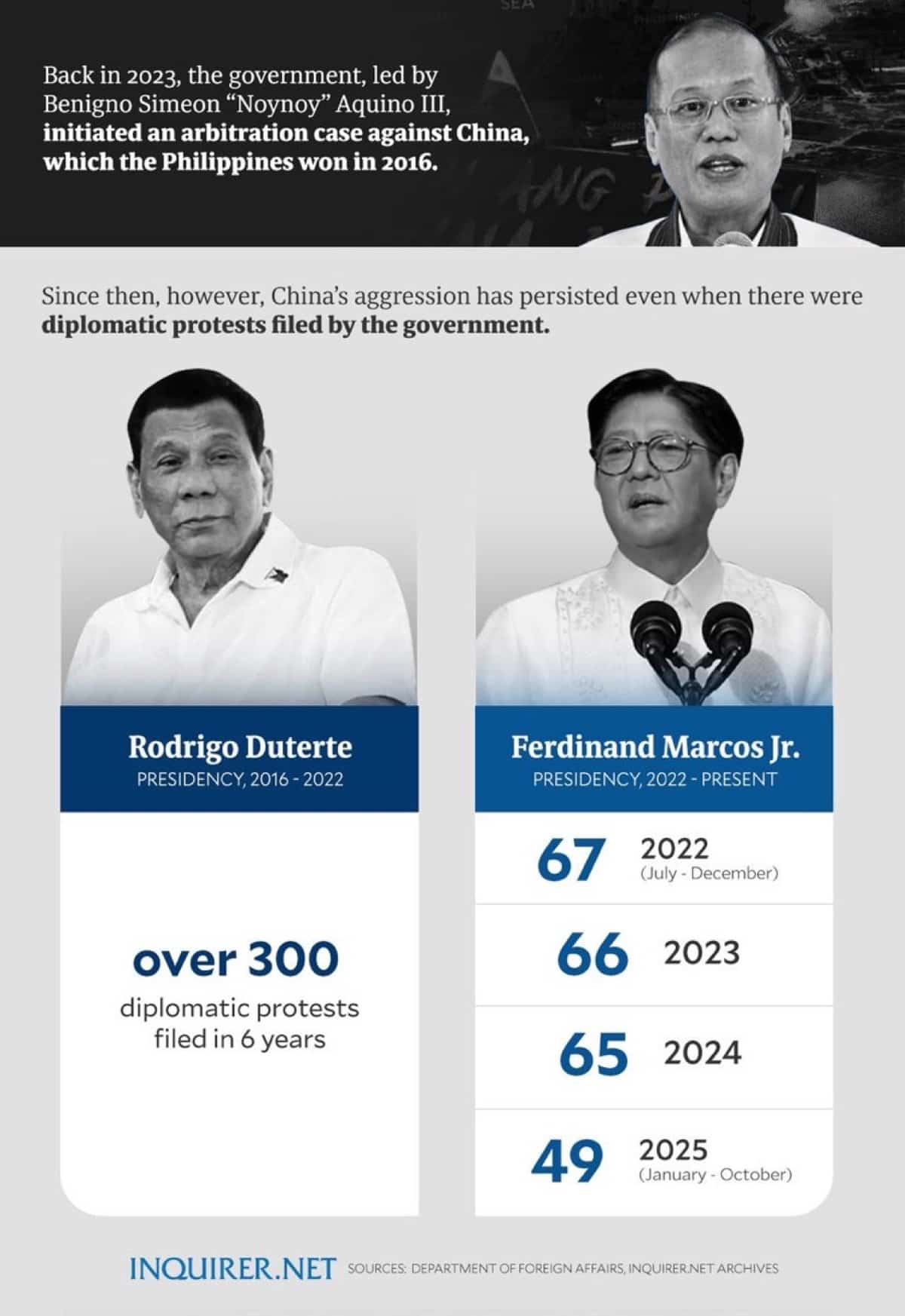
As pointed out by Cabalza, the Philippines cannot take a soft stand against China, which is engaging in a mind game to condition the government to choose silence over confrontation, especially since Marcos has renewed strengthened relationship with the US.
Tolentino explained that the Chinese government has consistently asserted that the US has no business interfering in the South China Sea issue because it can be managed bilaterally between China and the Philippines, or through the Association of Southeast Asian Nations.
RELATED STORY: PH: Unlawful for China to declare ‘nature reserve’ at disputed shoal
“It has always been more comfortable to deal with issues bilaterally rather than through the ‘interference’ of external powers,” she told INQUIRER.net.
But while it is really possible for the Philippines not to choose between the US and China, Tolentino stressed that it is “quite difficult at this point simply because of China’s actions that have pushed the Philippines to depend on the US for defense assistance and in playing as a stabilizer in the region.”
Filipino resiliency
But as Cabalza told INQUIRER.net, “what makes us safe would be the shifting politics and policies of the Philippines which are unnaturally known to the Chinese politburo,” pointing out that “they have a hard time in understanding the Filipino resiliency.”
“They always think that what made us lucky would be our alliance with the US which we have not yet fully exhausted,” he said.
He explained that China’s utterance about the Philippines’ “obstinate track to level off with their grey zone by outsmarting them in our globally acceptable lawfare have certainly championed our guts to set a gold standard in elevating and activating the principles of UNCLOS in which China in itself signed.”
“Our victory in that international legal battle proves our mind is right over might is right in the Indo-Pacific. It is game-changing as China still tries to counter that formidable decision of the arbitral court,” he said.
READ: PH wins arbitration case over South China Sea
Cabalza stated that the backlash they received from the success of the Philippines in grounding such a landmark case using the teeth of international law and continuous multiple defense pacts inked by the Philippines with major powers led to China’s imitation on the use of domestic legislations to fortify their coast guard law and nature reserve to shield them from their castigated ICAD attacks in the West Philippine Sea.
“Manila’s ingenuity and resiliency in using legal mechanisms, military modernization, and innovative defense policies helped the country to outwit China’s protracted coastal and naval ventures which they had long played since their dynastic period despite their massive military assets and increasing diplomatic mileage in the world on par with the US,” said Cabalza.
As he pointed out, the government should let China think that the Philippines is heavily dependent on the US “because Filipinos’ strategic culture is episodic and enigmatic that shows up in times of hard conflicts.”
“The Chinese knew that we were only passive to the Americans and timid in our national security, which is not the case. It is an underestimation, which somehow baffles not only China but also the US, and that’s the gist of our modern national security and resiliency infrastructures,” he said.
“Our bright strategies are emboldened despite the shortages in logistics and asymmetrical warfare,” Cabalza pointed out.
For comprehensive coverage, in-depth analysis, visit our special page for West Philippine Sea updates. Stay informed with articles, videos, and expert opinions.


