





PH Navy expands monitoring as Chinese ships transit nearby


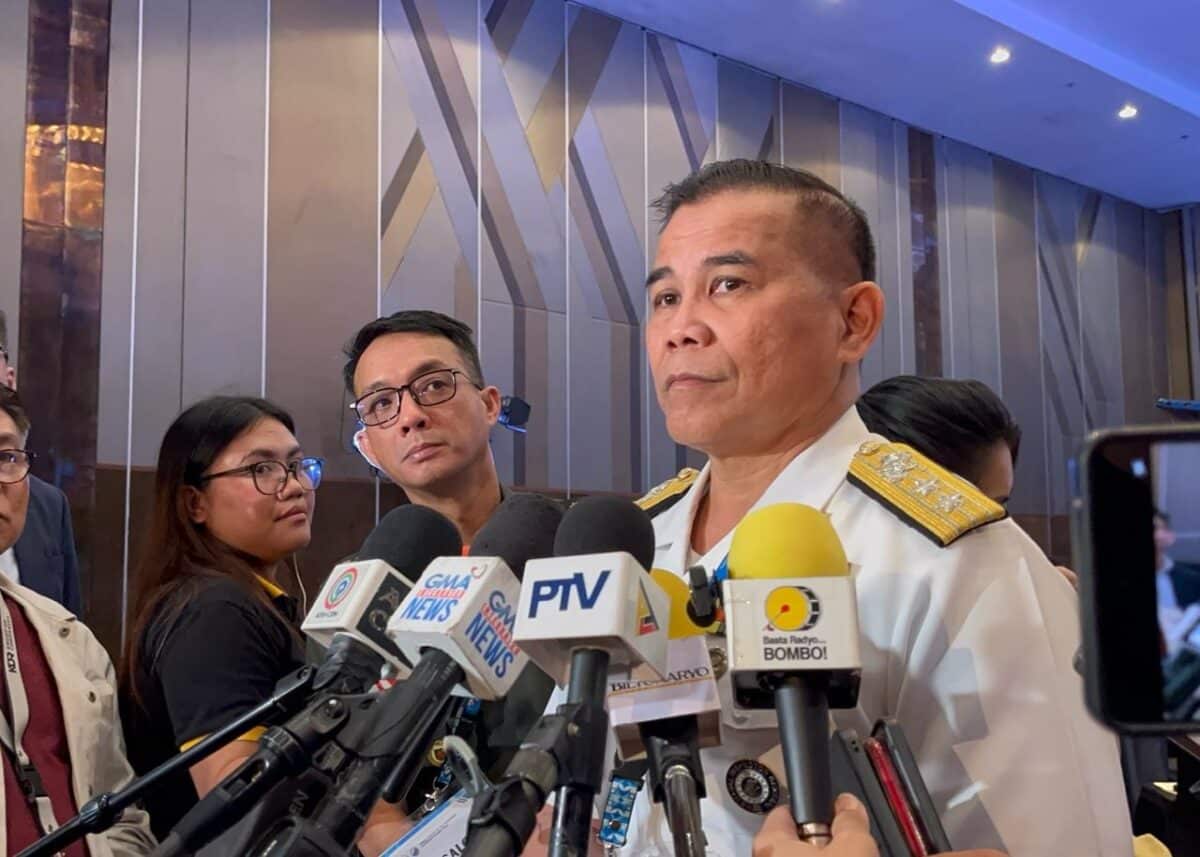
MANILA, Philippines — The Philippine Navy said on Tuesday it has broadened its regional monitoring after detecting separate Chinese carrier and amphibious task groups moving near the country’s periphery over the past week.
Navy spokesperson Rear Adm. Roy Vincent Trinidad said the Armed Forces of the Philippines (AFP) has shifted from a purely internal security focus to a broader external defense surveillance role, allowing it to track Chinese naval movements beyond the West Philippine Sea.
“Over the weekend and last week, we monitored a Chinese task group centered on an amphibious assault ship passing through the eastern seaboard of the Philippines, beyond our EEZ,” Trinidad said in a press briefing at Camp Aguinaldo in Quezon City. “We have also noted the Liaoning carrier battle group on the northeastern part of Luzon close to Okinawa.”
Trinidad said the two formations, though detected within days of each other, were operating far apart.
“They were roughly around six to eight hundred miles from Okinawa to our eastern seaboard,” he said.
According to the Navy, the Liaoning carrier group consisted of the aircraft carrier Liaoning, two escort vessels, and one replenishment ship.
The amphibious assault task group had a similar composition: an assault ship, two escorts, and a replenishment vessel.
Both groups remained well outside the Philippines’ exclusive economic zone, he said, stressing that the formations were transiting southward and not heading toward the country.
“They were just passing through, not even within our EEZ,” Trinidad said. “Their general direction was downward toward Palau or Australia.”
READ: AFP airs concern over China aircraft carrier group in PH Sea
He added that the amphibious group was tracked east of Samar and continued on a southward course.
While he declined to characterize the movements as a show of force amid Beijing’s tensions with Japan, Trinidad said Manila is closely watching regional developments, noting that the Philippines, Japan, and Taiwan all lie along the first island chain.
He added that, as President Marcos Jr. previously said, “any action in Taiwan and Japan would surely impact the Philippines.”
“What is important is that the actions, the intent, the objectives of these group sails must be transparent, and the actions of the ships, including their embarked aircraft, must be non-aggressive and abide by international law,” he said.
He highlighted that the AFP is now conducting monitoring “on a regional basis,” expanding its maritime domain awareness while maintaining internal security operations.
Trinidad also emphasized ongoing coordination with defense partners amid the increased activity.
READ: PH Navy trains with US carrier strike group for first time
“There is very good information sharing among our regional partners,” he said, referencing Manila’s expanding defense ties with Japan, Australia, New Zealand, and South Korea.
Historically, Trinidad said, Chinese carrier groups follow a recurring route: from mainland China through the Okinawa and Miyako straits; down the Philippine eastern seaboard; past Palau and Australia; and onward toward Indonesia’s Lombok Strait before looping back to the South China Sea via the Sibutu Channel.
The Navy said it will continue tracking such deployments as part of the AFP’s wider shift to external defense and expanded maritime situational awareness. /jpv
For comprehensive coverage, in-depth analysis, visit our special page for West Philippine Sea updates. Stay informed with articles, videos, and expert opinions.


