





Panatag collision shows China still mastering joint ops – PH Navy


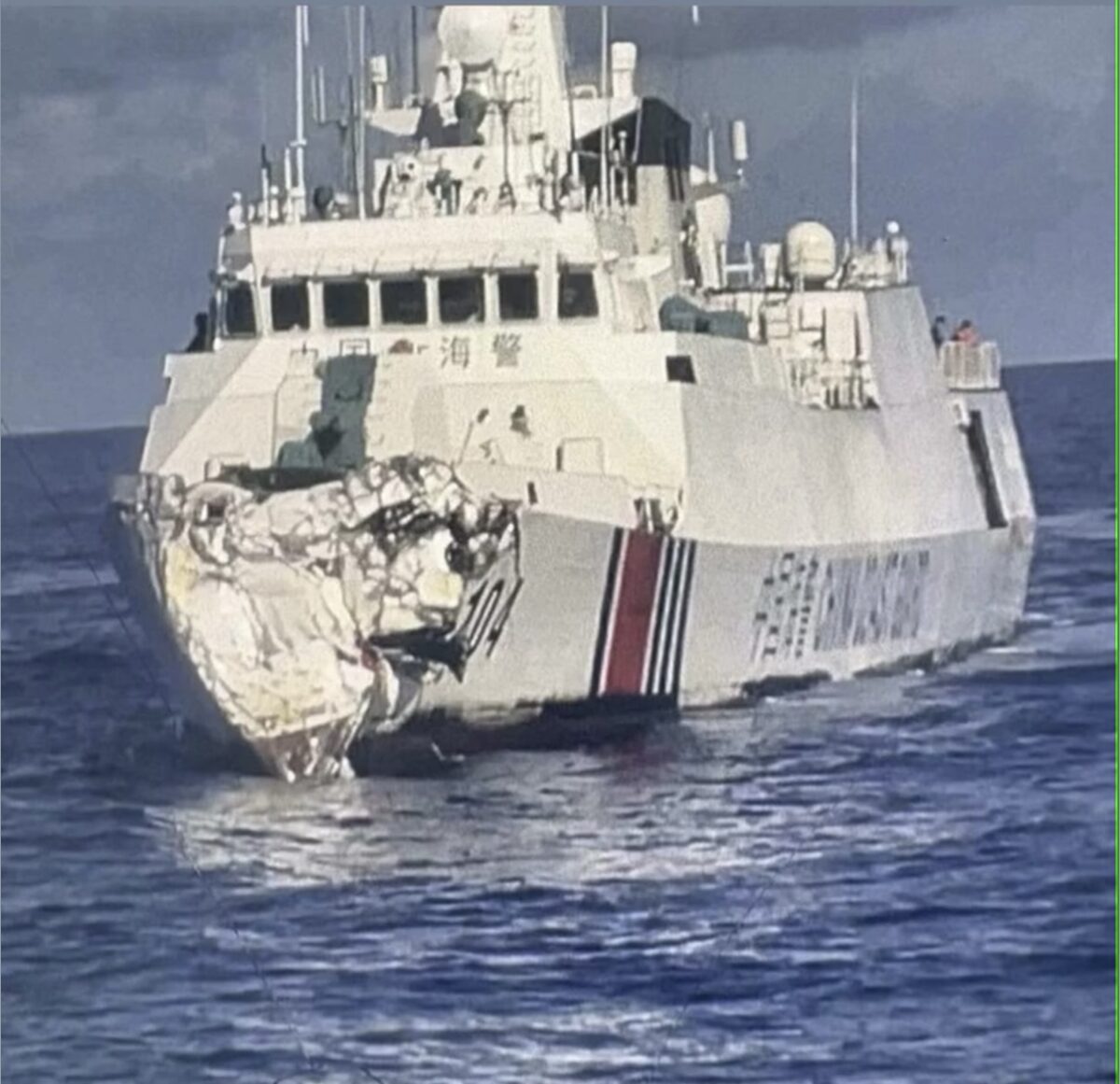
MANILA, Philippines — The recent collision of a Chinese Coast Guard vessel and a Chinese navy warship in Panatag (Scarborough) Shoal showed that China’s military is still trying to master joint operations as part of its change of tack, which also includes its latest move to lurk closer whenever the country is conducting West Philippine Sea joint drills with other nations.
Rear Admiral Roy Vincent Trinidad, Philippine Navy spokesperson for the West Philippine Sea, on Tuesday made these observations which he said are part of the Chinese military’s move for “integration.”
“They used to operate by service — air force, army and navy; today they are now integrating their air force, army, and navy, to include the coast guard and maritime militia and the other forces under the Central Military Commission,” Trinidad said in a regular military press briefing.
“If you look at their forces operating, they are still trying to perfect the way they do interagency operations as highlighted by the Aug. 11, [2025] collision between their China Coast Guard (CCG) and People’s Liberation Army-Navy (PLA-N),” he also said.
While chasing a 44.5-meter Philippine Coast Guard ship, an 80-meter CCG vessel instead collided with a 150-meter PLA-N warship. Both Chinese ships suffered damage with the CCG ship’s forecastle being crushed, while the PCG ship managed to evade the maneuver.
Trinidad said the collision is “one of the lessons learned that they get to go through.”
Although this collision highlighted the demand for the CCG, PLA-N and even its militia ships to integrate, Trinidad noted that the move appeared to have been a “trend for the past five to eight years.”
Aside from the PLA-N warship’s direct participation, last year also saw the militia ships’ usage of water cannons.
READ: Chinese ‘fishing boat’ uses water cannons against Filipino fishers
Chinese forces closer during 2025 MMCAs
Also part of this trend was the observed closer distance of CCG vessels and PLA-N warships in the exercise perimeter of the joint military drills of the country and its partner-nations.
“They are closer to the ships participating in the different MMCAs that we have conducted with like-minded nations,” Trinidad said, referring to multilateral maritime cooperative activity.
Patrols with other nations, which was halted by former President Rodrigo Duterte, resumed in 2023 under his successor, Ferdinand Marcos Jr.
A year after it resumed, Trinidad noted the Chinese forces used to be “at a distance in the horizon” whenever multilateral patrols took place.
But for 2025 — which saw over a dozen joint patrols with other nations — were observed to be at 10-15 nautical miles (NM) away, and, in few instances, even as close at six to eight NM from the exercise box, according to him.
Security expert Chester Cabalza said such actions of Beijing forces was “expected” and meant to “intimidate” to “oppose external interference from their view.”
“However, as a sovereign state, Manila has legal rights to exercise MMCAs,” Cabalza, president of the Manila-based think tank International Development and Security Cooperation, told Inquirer on Tuesday.
Through its “10-dash line,” Beijing claims sovereignty in almost the entire South China Sea, but Manila brought the matter to an international court, which effectively ruled in favor of its sovereign rights in 2016.
“China sees the MMCA as a strong statement of global powers in enforcing the 2016 arbitral award,” Cabalza also said.
“It is expected that PLA-N will distract our navy,” he added.
Nevertheless, Trinidad said “there will be an increase in our multilateral engagement and exercises” for 2026 in line with the military’s strategic thrust.
24 CCG ships, warships in WPS
In a related development, Trinidad said there has been an increase in the PLA-Navy and CCG presence in “all over the maritime features of the Philippines” based on data in previous years.
For the first week of January, the Navy monitored a total of 41 Chinese assets in four maritime features in the West Philippine Sea.
Of these 41, five PLA-N warships and 19 CCG vessels for a total of 24.
These 24 were a bit more than the combined 20 CCG ships and PLA-N warships logged in the previous month of December last year.
“If you compare this with the previous data that we have, this is still, it’s still quite within the numbers that we have been monitoring,” Trinidad said. “We foresee that for 2026, this would be the likely trend, increased presence in our maritime features of the PLA-Navy, the coast guard, and the maritime militia.” /das/cb
For comprehensive coverage, in-depth analysis, visit our special page for West Philippine Sea updates. Stay informed with articles, videos, and expert opinions.


