





Japan turns over 5 coastal radar systems to PH


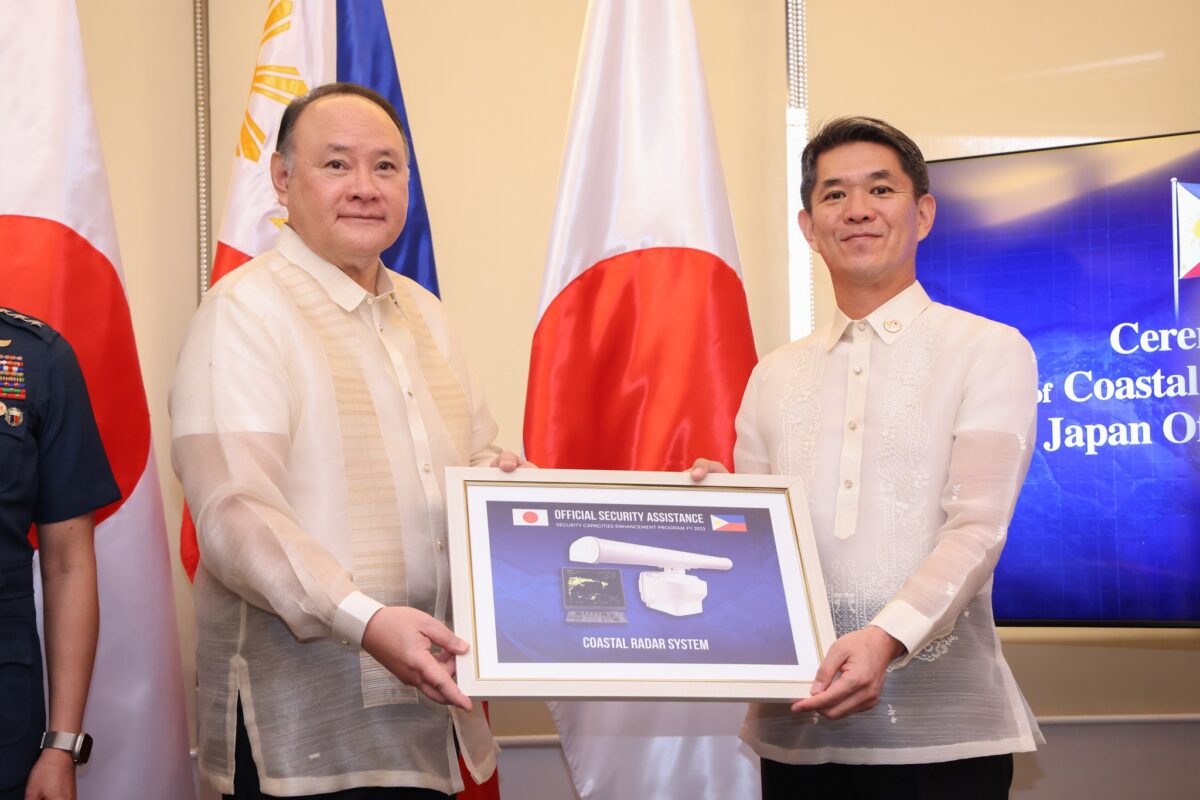
MANILA, Philippines — The Japanese government on Wednesday formally turned over five coastal radar systems which the Philippine Navy said will enhance its monitoring capability in the country’s waters.
Defense Secretary Gilberto Teodoro Jr. and Japanese Ambassador Endo Kazuya, graced the turnover ceremony at Camp Aguinaldo in Quezon City.
“I’d like to thank the Government of Japan for the concrete contributions in widening and deepening our bilateral and multilateral ties,” Teodoro said in his remarks during the ceremony.
This project is facilitated under Japan’s Official Security Assistance for Fiscal Year 2023 worth 600 million yen (P228.4 million).
The Japanese embassy said the coastal radar systems arrived in the country last Jan. 14.
“Once operational by the Philippine Navy, they are expected to significantly enhance the country’s maritime domain awareness by improving the ability to monitor activities in the surrounding waters,” Kazuya said.
Navy spokesperson Capt. Marissa Martinez told the Inquirer on Wednesday that the coastal radars will be distributed and installed at different naval monitoring stations “[on] the second [to] third week of February.”
However, Martinez said the Navy could not yet disclose their location due to operational security.
Nevertheless, she said the radars “will enhance the maritime domain awareness of the Navy” and the military.
“For an archipelagic country like the Philippines, having robust and reliable radar systems are vital in safeguarding our country’s vast maritime domain, upholding our sovereignty, and protecting our maritime interests,” she further said in a Viber message.
To date, the country’s latest and most modern detection system is also Japanese-made and was positioned near the West Philippine Sea.
The Wallace Air Station in La Union serves as the home of the J/FPS-3ME warning and control radar system built by Mitsubishi Electric Corp.
Inaugurated in December 2023, the system features an active electronically scanned array, an instrumented range of over 300 nautical miles, a 95 percent detection probability, and capabilities for both air defense and ballistic missile defense, according to the Philippine Air Force.
Kazuya noted that the South China Sea is a vital sea lane for many countries where “a large portion of our trade and energy supplies pass.”
Parts of the South China Sea saw mounting tensions between Manila and Beijing as the latter continues to assert its sovereignty claim over the maritime area which includes most of the West Philippine Sea.
The 2016 Arbitral Award, however effectively dismissed Beijing’s sweeping claim while essentially upholding Manila’s sovereign rights.
“Safety, openness, and stability of these waters are therefore of direct importance to our own security and prosperity,” Kazuya said.
“Enhancing the Philippines’ maritime domain capability is not only an investment in the Philippines’ security, but also a meaningful contribution to regional and global stability,” Kazuya added.
Manila and Tokyo also have a Reciprocal Access Agreement which eases restrictions on the movement of personnel and equipment on each other’s soil. /gsg/cb


