





Sailors cite repeated cyanide fishing in Ayungin, China claim rejected


MANILA, Philippines — The Armed Forces of the Philippines (AFP) said Tuesday that cyanide fishing appears to be recurring in Ayungin Shoal in the West Philippine Sea, citing multiple encounters and laboratory-confirmed findings, even as China dismissed the allegations as fabricated.
The response came after Chinese Foreign Ministry spokesperson Guo Jiakun dismissed the report as a “cyanide stunt,” reiterated Beijing’s claim that Ayungin Shoal is part of China’s Nansha Qundao, and accused Philippine forces of illegally harassing Chinese fishermen and seizing their supplies.
AFP spokesperson for the West Philippine Sea Rear Adm. Roy Vincent Trinidad said the military stands by its findings, which were backed by laboratory testing.
“All of our actions are based on scientific evidence. We do not fabricate,” Trinidad said in a briefing at Camp Aguinaldo in Quezon City.
“It took more than a year to have this liquid checked and confirm that it contained cyanide,” he added.
He said the National Bureau of Investigation confirmed through laboratory analysis that the seized liquid tested positive for cyanide.
Trinidad also rejected Beijing’s claim that Philippine forces harassed Chinese fishermen, accusing Chinese state-linked vessels of conducting “illegal, coercive, aggressive and deceptive” activities.
“These measures have been the cause of instability not only in the West Philippine Sea but in other parts of the globe,” he said.
READ: West Philippine Sea: China dumping cyanide in Spratlys, PH says
The AFP said containers were recovered in three separate operations during patrols near Ayungin Shoal involving fishermen aboard small wooden fishing boats, or sampans.
“Because of operational concerns, we did not apprehend them or arrest them. That would have meant bringing them aboard the ship,” Trinidad said.
He said most inspected sampans carried illegal fishing paraphernalia.
“Most of the sampans contained illegal fishing paraphernalia. There was no indication of any authorized fishing gear onboard,” he said.
Repeated encounters
In an interview at Camp Aguinaldo, Navy personnel deployed aboard BRP Sierra Madre said similar encounters occurred during those months near the Philippine-held outpost.
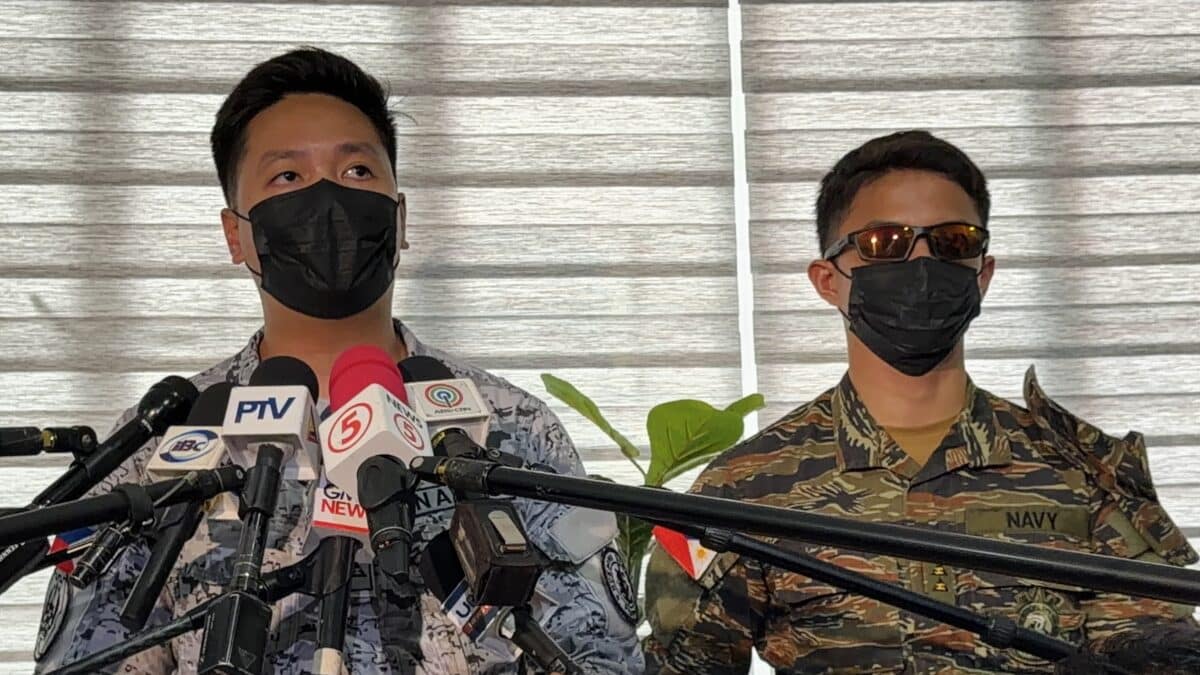
The sailors, identified only by their aliases “Hermes” and “Poseidon,” said Chinese sampans repeatedly approached Ayungin during patrols.
They wore face masks during the interview to conceal their identities, which AFP Public Affairs Office chief Col. Xerxes Trinidad said was necessary to prevent security breaches.
Both are Lieutenant Junior Grade officers.
Hermes said troops used rubber boats to intercept one of the vessels after tracking its movement near the area.
“At that time, we only suspected the bottles contained cyanide. But with the recent confirmation, it tested positive,” he said.
He said personnel observed containers onboard that immediately raised suspicion.
The fishermen, he added, did not respond or attempt to explain themselves.
“They did not give explanation. They did not try to speak. Their actions showed they wanted to get away and avoid being apprehended,” Hermes said.
In one nighttime encounter in October 2025, Hermes recalled how troops moved to stop a sampan that had approached the Sierra Madre.
“Our troops tried to stop them from moving away from where they were intercepted,” he said.
He added that officers saw containers onboard even before boarding the vessel.
“With the naked eye, we saw containers in their boat. At that time, we only suspected that it contained cyanide,” he said.
Hermes said the troops did not touch the Chinese fishermen or use force or projectiles during the encounter.
He added the sampan was later allowed to return to its mother vessel after its engine was fixed.
“When we stopped them, we waited for their engine to be fixed and made sure they returned safely to their mothership,” he said.
Environmental damage
Poseidon, who had spent extended periods in the area, said repeated encounters and visible coral degradation have raised concern among troops.
“It’s sad because Ayungin… I saw the bottom of it during my stay there. I was there for a long time. It’s so beautiful. It’s just sad that some parts are already dead,” he said in Filipino.
He said coral conditions in the area have visibly worsened over time.
Trinidad said reef damage around the outpost was “quite extensive,” citing other destructive fishing practices observed in the area, including fine mesh nets and barrier nets.
“These nets are designed to hamper our resupply missions and have also contributed to coral damage,” he said.
He said the matter would be referred to the Department of Foreign Affairs for possible diplomatic action. /cb


