





DFA chief’s South China Sea approach risks normalizing Beijing’s coercion


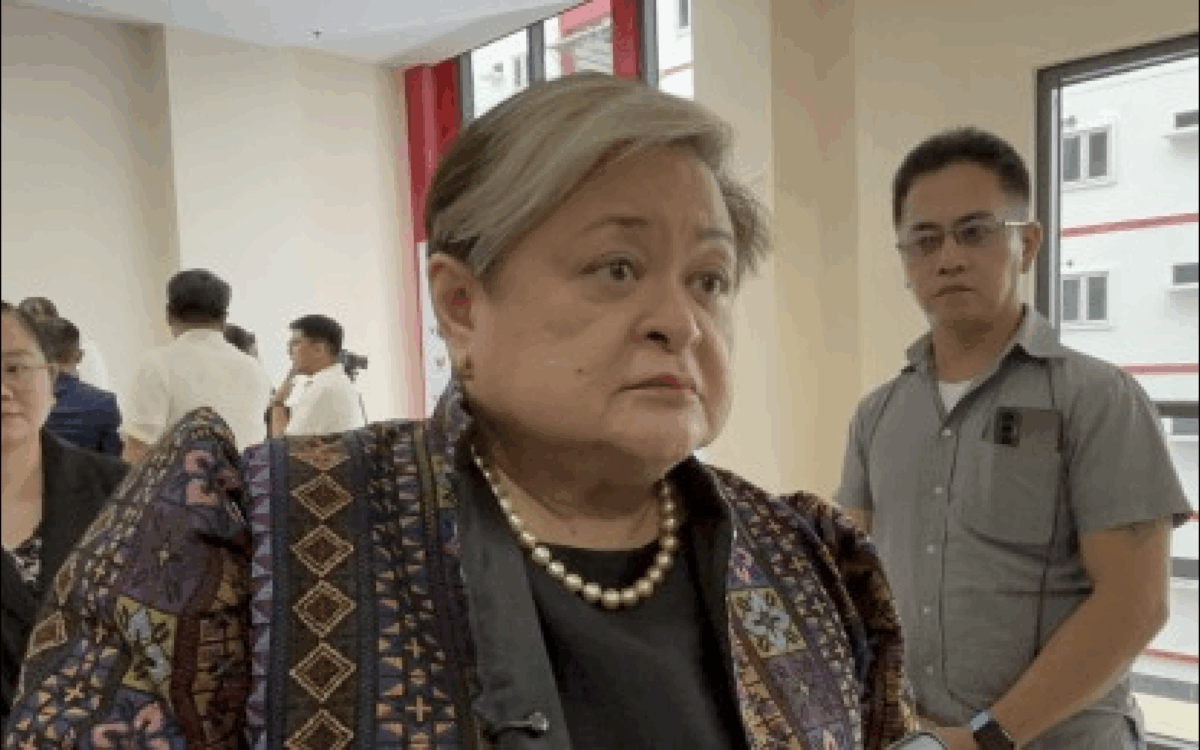
In a letter dated January 20, 2026, Foreign Affairs Secretary Ma. Theresa P. Lazaro responded to Senator Risa Hontiveros’ concerns regarding public statements made by Chinese diplomat stargeting Commodore Jay Tarriela and other Philippine officials amplifying the government’s transparency initiative. While the letter affirms the Philippines’ legal position under UNCLOS and the 2016 arbitral award, its deeper message is unmistakable: the Department of Foreign Affairs under Secretary Lazaro, perceives the credible, timely, and graphic documentation and public exposure of Chinese aggression against Philippine public vessels and Filipino fishermen, not as strategic necessity, but as an irritant depriving it of “diplomatic space.” Disputes, she argues, are “best addressed” quietly behind closed doors. This posture reflects a troubling return to an outdated diplomatic approach—one that history has already shown to be ineffective, and in the South China Sea context, dangerous.
One of the most consequential policy shifts adopted by the Marcos Administration has been the West Philippine Sea transparency initiative. This is done mainly by leveraging one of the Philippines’ most cherished democratic values—freedom of the press—embedding news journalists aboard Philippine Coast Guard (PCG) vessels. In parallel, the PCG, through its West Philippine Sea Transparency Group releases primary source incident images and videos, further corroborating what news journalists report to the public. Furthermore, Tarriela’s office keeps a record of Chinese presence in Philippine waters, enabling tracking and identifying trends of Chinese coercion over time.
The policy has denied Beijing the ability to shape policy and public discourse on the issue of the South China Sea and limited the influence of its malign influence operations that continuously try to portray the Philippines as the source of maritime tensions. Disinformation on the issue has become less potent despite the proliferation of pro-China propagandists and pseudo-experts on social media. The policy is also popular among Filipinos, with 94% supporting its continuation.
READ: China-PH ‘word war’ may delay South China Sea code – Tulfo
Moreover, the policy has paid dividends. International support has strengthened in favor of adherence to international law. Since Marcos came to power, 19 additional governments—including India, South Korea, Norway, France, Italy, and 14 other European states—have publicly reaffirmed that the 2016 Arbitral Award is legally binding and must be respected, bringing the total number to 60.
It is therefore deeply concerning that the country’s top diplomat appears increasingly uncomfortable with the transparency approach. “Differences and disputes between States are best addressed through established diplomatic channels rather than in public,” Lazaro said, without insisting on the transparency approach as if to say, the PCG should tone it down if not stop it altogether. This is not merely a preference for diplomacy; it is a rejection of the very logic of the transparency initiative: exposing Chinese coercion and dangerous maneuvers in real time, presenting inconvertible evidence, mobilizing international support, and denying China public and policy narrative control.
Secretary Lazaro’s letter repeatedly emphasized the need to preserve “space for dialogue and consultation.” Given the Philippines hosting of ASEAN and the South China Sea Code of Conduct negotiations, such idea can be tempting. But it reflects a familiar temptation in Philippine diplomacy: the belief that stabilizing diplomatic climate can moderate China’s behavior and allow it compromise.
Unfortunately, three decades of South China Sea discussions present no such indication. History shows that China’s maritime expansion has always depended on diplomacy characterized by such abstract concepts as needing “diplomatic space,” exploring confidence-building measures first, through cooperation on less sensitive issues, or agreeing to do something “when the time is ripe.” By creating a false atmosphere of cooperation and an impression it is willing to compromise, Beijing has succeeded in incrementally normalizing its unlawful acts and graduallymoved its forces closer to Philippine shores, at times enough to project effective control or occupation. There has been numerous literature on Beijing’s salami-slicing strategy. The transparency policy disrupts that strategy. Hence, stopping Tarriela tops Beijing’s Philippine agenda. Whether intentional or not, Secretary Lazaro’s approach risks advancing conditions long sought by Beijing while offering little to enhance Philippine strategic leverage.
READ: Chinese Embassy fires back: ‘We oppose groundless attacks and smears’
Some within the policy circles in Manila suggest that part of this caution stems from a desire to secure high-level Chinese participation in regional meetings, including the possibility of President Xi Jinping attending the East Asia Summit hosted by the Philippines in case a landmark COC is completed. But Philippine foreign policy cannot be reduced to summit optics.Beijing has attended countless ASEAN meetings, issued joint statements, embraced cooperative language, and spoken of countless confidence-building measures—while simultaneously building artificial islands, militarizing features, rejecting the 2016 arbitral ruling, and escalating coercive operations against the Philippines and other littoral Southeast Asian states. The so-called “diplomatic space” and the absence of the transparency policy in the past had not softened China’s position. So one must ask: at what cost? A photo-op with Xi Jinping and platitudes in exchange for silence on the West Philippine Sea?
READ: China embassy called out over tiff with PH execs
Diplomacy should not be an end in itself. Dialogue that demands Philippine restraint or silencewhile China continues coercion is not promoting stability and the rule of law. It is subordinating longterm Philippine interests to China’s expansionist goals.
The Philippines does not need to speculate about the dangers of secrecy and what the current DFA is framing as “restraint.” It has lived them. China’s maritime advances at the expense of Philippine rights and international law, have repeatedly occurred, not despite Philippine caution, but during periods when Manila placed faith in quiet diplomacy, private understandings, and confidence-building measures – the same “diplomatic space” that the DFA is demanding now to fashion a favorable agreement with China. The record is sobering.
Scarborough Shoal, 2012
In 2012, when Chinese government vessels blocked, for the first time, the Philippine Navy’s longstanding patrol of the Scarborough Shoal, the pressure was to deescalate. There was a discussion, shielded from the public, for a mutual pullout to end the standoff. Diplomatic space was needed, they said then, to dial down the tension. An agreement was reached. Manila withdrew its ships. Beijing did not. The rest is history.
China later denied that it ever agreed to such an arrangement, and the Scarborough Shoal has remained under de facto Chinese control ever since. This was not simply a diplomatic misunderstanding. It offered a lesson that Secretary Lazaro should heed: private understandings and diplomatic negotiations with China, without transparency, are a recipe for disaster.
The JMSU Fiasco
On March 15, 2005, the Philippines, China and a reluctant Vietnam signed the “Tripartite Agreement for Joint Marine Scientific Research in Certain Areas in the South China Sea,” or the Joint Seismic Marine Undertaking (JSMU). The joint exploration project initially began as a Sino-Philippine initiative, and covered an area of 55,168 sq. miles west of Palawan, more than 9,000 sq. miles of which were parts of undisputed Philippine exclusive economic zone (EEZ), measured from Palawan’s baselines. JMSU was supposed to serve as a confidence-building measure per the 2002 China-ASEAN Declaration on the Conduct of Parties in the South China Sea, and as a test case for joint exploration. It failed in both.
There was insufficient public scrutiny prior to JMSU’s signing. Transparency was absent. One clause reads, “this agreement and all relevant documents, information, data and reports” shall be kept confidential for eight years. According to the Philippine Center for Investigative Journalism, JMSU was directly connected to the $904.38 million package of investment pledges from China that included the graft-ridden Northrail construction and NBN-ZTE broadband deal, projects that were eventually cancelled.
The JMSU, marketed as “cooperation on less sensitive areas,” blurred jurisdictional boundaries and opened the door for Chinese maritime presence in areas they were never present before, such as the Reed Bank—well within the Philippines’ EEZ under UNCLOS. Rather than stabilizing relations, such “diplomatic space” that the DFA is asking for now, normalized Chinese presence and coercion in Philippine waters, and allowed Beijing to change the status quo.
Transparency Policy as Complement to Diplomacy
The pattern is unmistakable. Should our own DFA and Beijing succeed in silencing Commodore Jay Tarriela and some of our elected leaders, and reversing the transparency policy, it would not moderate China’s behavior—it would only embolden it.
The Philippines should always pursue diplomacy. But diplomacy not grounded on data, on China’s record in the South China Sea, is not sound diplomacy. It is appeasement and subservience. What the DFA needs to do is to change its mindset and not view the transparency policy as counterproductive to diplomacy. Rather, the DFA should perceive transparency as a complement to diplomacy, to keep diplomatic engagements grounded on the truth, on accountability. Transparency is a key to strengthening diplomacy with China, one that advances Philippine interests and the primacy of international law.
Falsehoods and efforts to confuse the public must be exposed continuously and rapidly, and must be called out – even if they come from the Chinese Embassy, and more so while Manila holds the agenda-setting role within ASEAN. At present, the Department of Foreign Affairs often issues one-off rebuttals in the form of short statements, usually only after pressure from elected political leaders. This reactive approach cedes the information space and weakens our diplomacy.
What should be done?
First, the DFA should work closely with the Philippine Coast Guard, the Armed Forces of the Philippines, and the Department of National Defense to scale the WPS Transparency Group into a standing, inter-agency rapid response mechanism. Such a team should be empowered to debunk – within minutes rather than days – false or misleading claims issued by the Chinese Embassy in Manila, the Ministry of Foreign Affairs in Beijing, and their “wolf warrior” diplomats. Speed matters: in the information domain, narratives that go unchallenged quickly harden into perceived facts.
Second, the DFA should move beyond rebuttal and proactively institutionalize its own transparency initiatives – not view transparency as too offensive to China. Rather than merely responding to Chinese narratives, the DFA should work with the WPS Transparency Group, and assist in regularly publishing time-stamped evidence, clear timelines and records of incidents, and authoritative legal explanations grounded in UNCLOS and the 2016 Arbitral Award. These transparency efforts should be routinized, professionally packaged, and disseminated consistently across platforms, including social media.
Finally, transparency should not be treated as an ad hoc political tool, but as a standing policy instrument – one that makes Philippine actions predictably principled, verifiable, and difficult to misrepresent. By consistently saturating the information space with credible, primary-source material, the Philippines can prevent disinformation from gaining traction in the first place and Chinese diplomats from gaining the upper hand in any negotiation. Commodore Jay Tarriela and his team have shouldered much of this burden with remarkable consistency, professionalism, and commitment to the truth. It is time for the Philippine government to institutionalize and fully support these efforts at scale. If the Chinese refused to talk or to negotiate an effective COC because of the transparency policy, it would demonstrate a lack of good faith.
Secretary Lazaro’s letter reflects an outdated diplomatic approach. But the South China Sea has already demonstrated where that approach leads: to a militarized Mischief Reef, to a Chinese controlled Scarborough Shoal, to an energy-rich Reed Bank out of reach for Filipinos.
The old approach failed. The Philippines cannot afford to return to the patterns that enabled China’s expansion in the first place. In the West Philippine Sea, there must be no retreat from transparency. /dl
Dr. Jeffrey Ordaniel is the lead convenor of The Manila Dialogue on the South China Sea, and is an Associate Professor of International Security Studies at Tokyo International University.
For comprehensive coverage, in-depth analysis, visit our special page for West Philippine Sea updates. Stay informed with articles, videos, and expert opinions.


