





PH lawmakers hit China intrusion near Zambales: Feeling entitled?


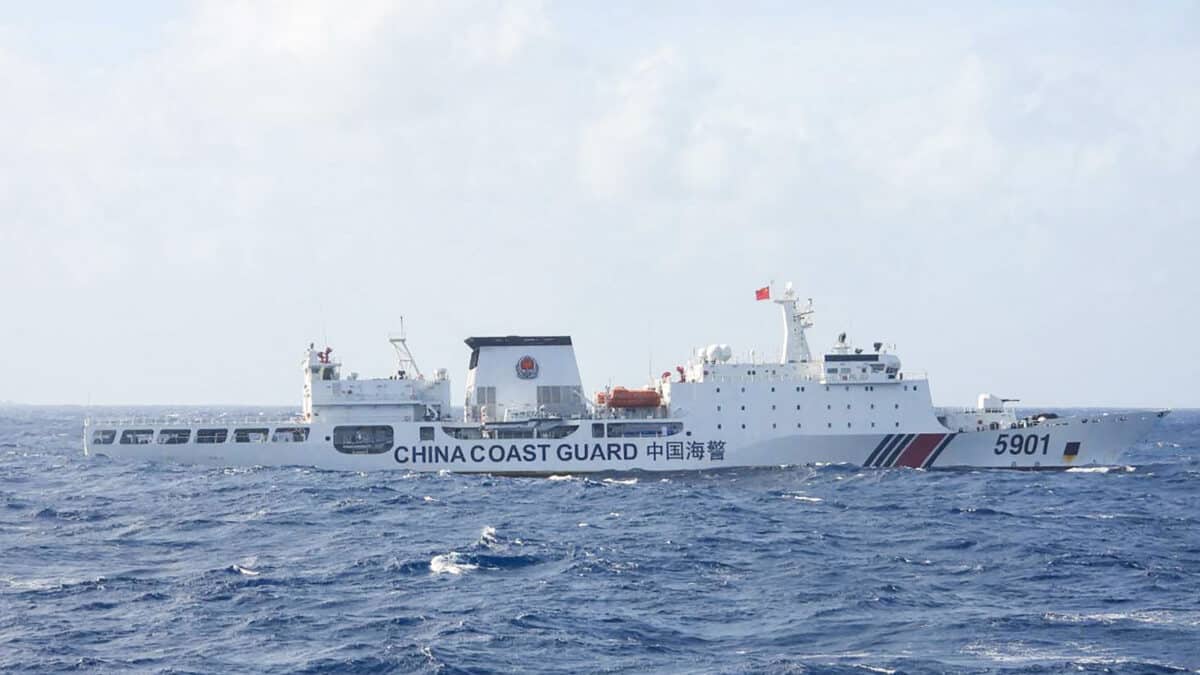
MANILA, Philippines — Lawmakers from the House of Representatives’ Minority bloc called out China over its recent intrusive actions after local authorities challenged the illegal presence of a China Coast Guard (CCG) vessel seen drifting just 48 nautical miles west of a town in Zambales.
In a statement on Wednesday, Mamamayang Liberal party-list Rep. Leila de Lima said the Philippine Coast Guard’s (PCG) decision to challenge China was commendable, especially since Beijing has been acting like a superpower entitled to bully other countries.
De Lima made the statement after the PCG reported on May 20 that CCG-4305 vessel was seen drifting 48 nautical miles west of Pundaquit, Zambales.
“This only shows our strong stand and proves that we will not remain silent when foreign forces try to intrude into our territory,” she said in Filipino.
“China’s refusal to acknowledge our radio challenges while within our exclusive economic zone (EEZ) demonstrates the behavior of a superpower that feels entitled to bully others,” she added.
According to PCG spokesperson for the West Philippine Sea (WPS) Rear Admiral Jay Tarriela, the vessel was initially detected within the EEZ through Canada’s Dark Vessel Detection (DVD) Program.
The incursion prompted PCG commandant Admiral Ronnie Gil Gavan to order the deployment of aerial and surface assets. The PCG aircraft visually confirmed the presence of CCG-4305 within the Philippine EEZ, 50.1 nautical miles west of Pundaquit, Zambales.
“The PCG aircrew issued numerous radio challenges, which the Chinese vessel refused to acknowledge. The PCG Piper Navajo 302 also conducted multiple passes to document the unlawful incursion before returning to the airport,” he said.
PCG vessel BRP Cape San Agustin proceeded to the location of the CCG ship and also conducted radio challenges throughout the day.
“Although the Chinese vessel briefly acknowledged the initial challenge in the morning, it subsequently went silent and refused to respond to subsequent challenges. Notably, CCG-4305 provided no lawful basis for its presence within the Philippines’ EEZ,” Tarriela said.
READ: PCG challenges unauthorized Chinese vessel off Zambales coast
De Lima said China’s refusal to acknowledge the radio challenges was a way of mocking the Philippine Maritime Zones Act and international law — something the Philippine government should consider in its plans for joint oil exploration projects with Beijing.
Discussions on joint exploration with China resurfaced after the United States-Iran war disrupted the movement of oil products worldwide and effectively drove prices upward.
Last April, the Department of Foreign Affairs assured the public that any potential joint oil and gas exploration with other countries would strictly adhere to the 1987 Constitution.
“Amid these continued harassment and intrusions, we should continue strengthening our partnership with regional allies to preserve and defend a rules-based international order, especially when it comes to enforcing the law of the sea,” De Lima said.
De Lima also called on her colleagues in the House of Representatives to pass House Bill No. 5131, or the “Revised Philippine Coast Guard Law,” citing the strategic importance of the country’s maritime domain. The bill seeks to strengthen the PCG through vital policy and organizational reforms.
Akbayan party-list Reps. Percival Cendaña and Dadah Kiram Ismula also said China’s actions reflected how it views the WPS issue.
“No proper and orderly dialogue can happen with China if its primary interest is claiming the West Philippine Sea and disregarding international law,” Cendaña said in Filipino.
“China still refuses to respect our sovereignty as it continues lingering near Zambales; we cannot trust it to engage in good faith in joint oil exploration,” Ismula said.
According to Ismula, China can start showing “good faith” by respecting the 2016 ruling of the Permanent Court of Arbitration (PCA).
Ismula was referring to the PCA ruling stating that the Philippines has exclusive rights over its waters and that China’s nine-dash line claim has no legal or historical basis.
“China can start by acknowledging and respecting the 2016 Arbitral Award, which states that the Philippines has exclusive rights to the WPS, and by starting accountability measures for the damage it caused to the seas. If China continues to imagine that the WPS belongs to it, it will likely also claim whatever oil may be extracted there,” she added.
The WPS, which forms part of the South China Sea, lies within the western portion of the Philippines’ exclusive economic zone (EEZ). China, however, continues to assert ownership over many islands within the WPS despite the PCA ruling favoring the Philippines.
In August 2023, a CCG vessel water-cannoned Philippine vessels delivering supplies to troops stationed aboard the grounded BRP Sierra Madre at Ayungin Shoal, which lies well within the Philippines’ 200-nautical-mile EEZ.
In response, China claimed that a previous administration had promised to remove BRP Sierra Madre from Ayungin Shoal, but that the commitment had not been fulfilled.
President Ferdinand Marcos Jr. later said he had not entered into such an agreement and that, if one existed, it had already been terminated.
Following a trilateral meeting among the Philippines, the United States, and Japan in Washington, D.C., in April 2024, Marcos said he was convinced that former President Rodrigo Duterte had entered into a secret deal with China regarding the WPS.
Marcos urged Duterte to come clean and disclose everything agreed upon with Beijing.
READ: Marcos to Duterte: ‘What did you compromise?’
“It is clear to me that something was concealed. There was a deal that they kept secret from the people,” Marcos told journalists. /mcm


